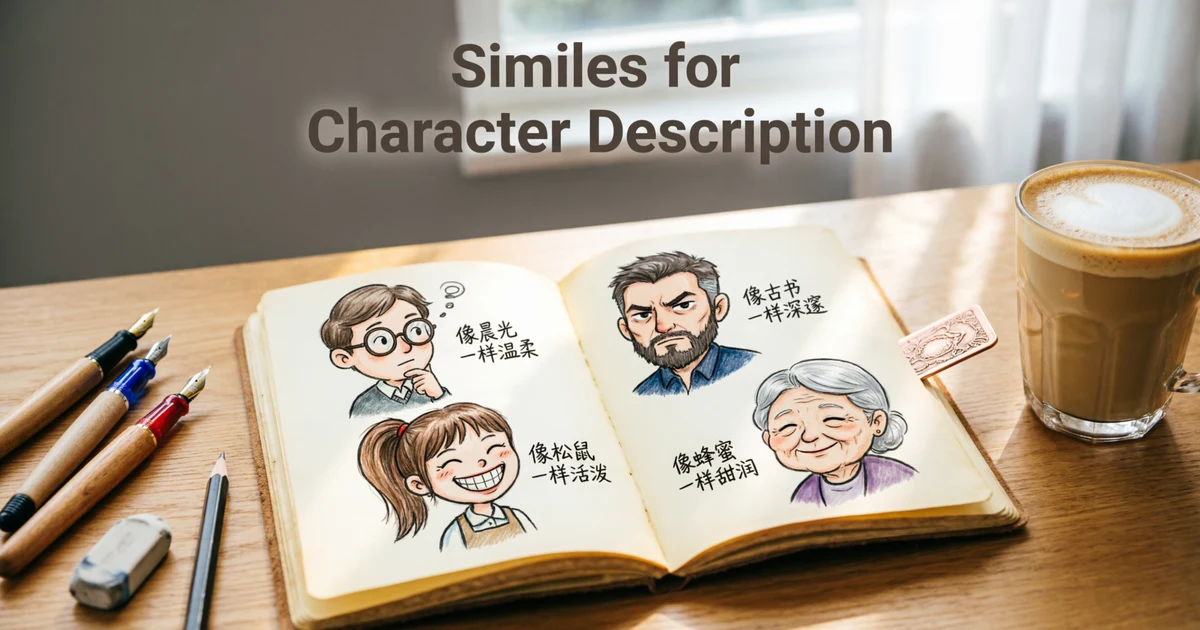
A strong character description does more than tell readers how someone looks. It helps them feel the person on the page. A good simile can turn a flat description into a clear image, a mood, or a personality clue. Instead of saying a character looks nervous, you can say she trembled like a leaf in a storm. That one line gives readers movement, emotion, and atmosphere.
In this guide, you will learn how to use a simile for character description in a natural and effective way. You will find similes for kindness, bravery, cleverness, anger, sadness, mystery, strength, fear, appearance, and personality. You will also see clear examples for stories, school essays, and creative writing, so you can describe characters with more life and meaning.
What Simile for Character Description Means in Simple Words
A simile for character description compares a person to something else using words like like or as. Writers use it to describe a character’s looks, actions, feelings, or personality in a clearer way.
For example:
- Her smile was as warm as morning sunlight.
- He stood like a guard dog near the door.
- His eyes moved like a fox searching for a way out.
Each simile helps the reader imagine the character more clearly. The first one shows kindness and warmth. The second one shows protection. The third one shows cleverness or suspicion.
A character simile can describe:
- Appearance
- Mood
- Personality
- Voice
- Movement
- Behavior
- Inner emotion
Simple description says, The boy was shy. A stronger simile says, The boy hid behind his words like a turtle inside its shell. That sentence gives the reader a picture and a feeling at the same time.
Why Writers Use Similes to Describe Characters
Writers use similes because plain description often feels too direct. A simile adds color without making the writing too long. It helps readers understand a character quickly through comparison.
For example, saying a man is tall gives basic information. Saying he stood like a pine tree in a field creates a stronger image. It tells the reader he looks tall, still, and noticeable.
Similes also help writers show personality through action. A kind character might move like a gentle breeze. A proud character might walk like a king entering his court. A nervous character might speak like a candle flickering in the wind.
Good character similes can:
- Make a person easier to picture
- Reveal emotion without long explanation
- Add style to essays and stories
- Create a stronger mood
- Help readers connect with the character
The best similes feel natural. They match the scene, the age of the character, and the tone of the writing.
Best Similes for Character Description With Meanings
Here are useful similes for character description with clear meanings and examples.
- As gentle as a lamb
Meaning: Very kind and harmless
Example: Her voice sounded as gentle as a lamb when she comforted the child. - As brave as a lion
Meaning: Very courageous
Example: He faced the crowd as brave as a lion. - As clever as a fox
Meaning: Smart and quick thinking
Example: The old merchant smiled as clever as a fox. - As quiet as a mouse
Meaning: Very silent or shy
Example: The new student sat as quiet as a mouse in the back row. - As cold as stone
Meaning: Emotionless or unfriendly
Example: His face stayed as cold as stone during the argument. - Like a storm waiting to break
Meaning: Angry or full of tension
Example: She stood by the window like a storm waiting to break. - Like sunshine in a dark room
Meaning: Cheerful and comforting
Example: Her laugh entered the house like sunshine in a dark room. - Like a shadow at midnight
Meaning: Mysterious or hard to understand
Example: The stranger moved like a shadow at midnight.
These similes work well because they connect a character trait with a familiar image.
Simple Similes for Character Description for Students
Students often need simple similes for stories, essays, and classroom writing. The best student similes stay clear and easy to understand.
Here are simple examples:
- She was as kind as a caring nurse.
- He was as fast as a rabbit.
- The teacher was as patient as a gardener.
- My friend was as funny as a clown.
- The baby was as soft as a pillow.
- The old man was as wise as an owl.
- The girl was as bright as a star.
- The boy was as nervous as a cat near water.
Students should choose similes that match the exact character trait. If a character feels scared, compare them to something small, shaky, or alert. If a character feels strong, compare them to a tree, rock, lion, or mountain.
A good school sentence might look like this:
Maya entered the classroom as quiet as a mouse, but her eyes shone as bright as stars.
This sentence describes both shyness and intelligence in a simple way.
Similes for Describing a Kind Character
A kind character often gives comfort, patience, and warmth. Similes for kindness should feel gentle, soft, and caring.
Useful similes include:
- As gentle as a lamb
- As warm as sunlight
- As soft as a mother’s touch
- As patient as a tree in summer
- Like a candle in a dark room
- Like rain on dry ground
- Like a safe blanket on a cold night
Examples:
Her words felt as warm as sunlight on a winter morning.
He treated every child like a gardener caring for young flowers.
Aunt Sara smiled like a candle in a dark room, small but comforting.
When you describe a kind character, focus on how that person makes others feel. Kindness often appears through voice, hands, eyes, and actions. A character who listens carefully may feel as steady as a quiet lake. A character who helps others may seem like a bridge over troubled water.
Similes for Describing a Brave Character
A brave character does not always feel fearless. True bravery often means facing fear and still moving forward. Strong similes for bravery should show courage, strength, and determination.
Good examples include:
- As brave as a lion
- As bold as fire
- As steady as a mountain
- Like a soldier at the gate
- Like a ship facing high waves
- Like a flame refusing to die
- Like an eagle flying into the wind
Examples:
He walked toward the danger as steady as a mountain.
She stood before the bully like a flame refusing to die.
The young hero stepped into the cave like a ship facing high waves.
Bravery similes work best when they include action. Instead of only saying a character is brave, show how they move, speak, or stand. A brave character might lift their chin, hold eye contact, or protect someone weaker.
Similes for Describing a Clever Character
A clever character notices details, solves problems, and thinks quickly. Similes for cleverness often connect the character to sharp eyes, quick animals, puzzles, or light.
Useful similes include:
- As clever as a fox
- As sharp as a needle
- As quick as lightning
- Like a chess player seeing five moves ahead
- Like a key finding the right lock
- Like a hawk watching from above
- Like a spark jumping from dry wood
Examples:
His mind worked like a key finding the right lock.
The detective watched the room like a hawk watching from above.
She answered the riddle as quick as lightning.
Clever character similes should not only say someone is smart. They should show how the mind works. Some clever characters act calm. Others speak fast. Some hide their intelligence until the right moment. Choose the comparison that matches the character’s style.
Similes for Describing a Funny Character
A funny character brings energy to a scene. Similes for humor can show playfulness, surprise, silliness, or charm.
Helpful similes include:
- As funny as a circus clown
- As playful as a puppy
- As lively as a song at a party
- Like a firework in a quiet street
- Like a joke waiting to happen
- Like a dancing monkey in a serious room
- Like sunshine with messy hair
Examples:
He entered the room like a joke waiting to happen.
Her laugh bounced around the kitchen like a song at a party.
My little brother acted as playful as a puppy with a new toy.
Funny similes should match the tone. A light comedy scene can use silly images. A realistic story may need softer humor. Instead of making the character sound foolish, show how they lift the mood or surprise others.
Similes for Describing a Shy Character
A shy character may avoid attention, speak softly, or hide emotions. Similes for shyness often use small animals, shadows, quiet places, or closed objects.
Useful similes include:
- As quiet as a mouse
- As shy as a deer near a road
- As hidden as a pearl in a shell
- Like a turtle inside its shell
- Like a whisper in a crowded room
- Like a flower closing at night
- Like a shadow behind a curtain
Examples:
She stood near the door like a flower closing at night.
The boy answered as quietly as a whisper in a crowded room.
He pulled his sleeves over his hands like a turtle inside its shell.
Shy character similes work well when they show body language. Look at the eyes, hands, shoulders, voice, and distance from others. A shy person may not say much, but their movements can reveal a lot.
Similes for Describing an Angry Character
An angry character needs strong, vivid language. Similes for anger often use fire, storms, wild animals, heat, and sharp objects.
Strong similes include:
- As hot as fire
- As fierce as a wolf
- As sharp as broken glass
- Like thunder before a storm
- Like a volcano ready to erupt
- Like a kettle boiling over
- Like a bull seeing red
Examples:
His voice grew as sharp as broken glass.
She paced the room like a volcano ready to erupt.
The coach shouted like thunder before a storm.
Anger similes should fit the level of emotion. Mild anger may feel like a kettle beginning to boil. Deep rage may feel like a wildfire. Do not use the biggest image for every angry moment. Save the strongest similes for scenes with real tension.
Similes for Describing a Sad Character
A sad character often feels heavy, quiet, empty, or distant. Similes for sadness should carry emotional weight without sounding overly dramatic.
Useful similes include:
- As lonely as an empty road
- As heavy as a rain cloud
- As quiet as a room after goodbye
- Like a flower without sunlight
- Like a bird with a broken wing
- Like a candle burning low
- Like a song with no music
Examples:
Her face looked as heavy as a rain cloud.
He sat by the window like a bird with a broken wing.
After the news, she moved through the house like a song with no music.
Sadness works best through small details. A sad character may stare at the floor, speak slowly, avoid food, or smile without meaning it. The simile should support that quiet feeling.
Similes for Describing a Mysterious Character
A mysterious character makes readers curious. They may hide secrets, speak little, appear suddenly, or seem hard to read. Similes for mystery often use darkness, mist, locked doors, shadows, and hidden paths.
Good examples include:
- As silent as midnight
- As unreadable as a closed book
- As distant as the moon
- Like a shadow slipping through an alley
- Like fog over a lonely road
- Like a locked room with no key
- Like a question no one dared to ask
Examples:
The woman at the gate looked as unreadable as a closed book.
He spoke like a question no one dared to ask.
The stranger passed through the market like fog over a lonely road.
Mystery similes should create curiosity, not confusion. Give readers enough detail to feel intrigued. A mysterious character needs hints, not full explanation.
Similes for Describing a Strong Character
A strong character may have physical strength, emotional strength, or moral strength. Similes for strength often use rocks, trees, mountains, iron, storms, and roots.
Useful similes include:
- As strong as an ox
- As firm as a rock
- As steady as an old oak tree
- Like a mountain in rough weather
- Like iron under pressure
- Like roots gripping deep soil
- Like a wall standing against the wind
Examples:
Her courage stood like a wall against the wind.
He carried the heavy box as easily as an ox pulling a cart.
Grandmother stayed as steady as an old oak tree during the crisis.
Strength does not always mean muscle. A quiet character can have great strength. A mother who works through hardship, a student who keeps trying, or a friend who tells the truth can all show strength.
Similes for Describing a Weak or Nervous Character
A weak or nervous character may shake, hesitate, speak softly, or doubt every step. Similes for nervousness often use fragile objects, small animals, trembling leaves, and flickering lights.
Helpful similes include:
- As nervous as a cat in a room full of dogs
- As shaky as a leaf in the wind
- As weak as wet paper
- Like a candle in a storm
- Like a bird trapped in a room
- Like glass about to crack
- Like a small boat on rough water
Examples:
His hands shook like leaves in the wind.
She stood before the judges like a small boat on rough water.
His voice sounded as weak as wet paper.
Use these similes carefully. Weakness can sound insulting if the tone feels harsh. In serious writing, focus on vulnerability rather than mockery. A nervous character can still have depth, intelligence, and courage.
Similes for Character Appearance and Personality
Character description often blends appearance and personality. A person’s face, posture, clothing, and movement can hint at inner traits.
Examples for appearance:
- Her hair shone like black silk.
- His eyes were as bright as polished glass.
- His back bent like an old branch.
- Her smile opened like a flower in spring.
Examples for personality:
- He was as proud as a king.
- She was as honest as clear water.
- He was as restless as a bird in a cage.
- Her kindness spread like warmth from a fire.
A strong character description connects outer detail with inner meaning. Instead of listing hair color, eye color, and height, choose details that reveal something about the person.
For example:
His coat hung from his shoulders like a tired flag, but his eyes burned like fresh coals.
This sentence shows appearance and personality together. The coat suggests weariness. The eyes suggest energy or determination.
Similes for Character Description in Stories
Stories need character similes that match the scene. A fantasy story may use magical or dramatic comparisons. A realistic school story may need everyday images. A mystery story may use darker and quieter similes.
Story examples:
- The old sailor laughed like waves hitting rocks.
- The princess walked like moonlight across marble.
- The thief moved like smoke through the crowd.
- The farmer’s hands felt as rough as tree bark.
- The little girl followed her brother like a duckling after its mother.
A good story simile should do more than decorate the sentence. It should reveal mood, setting, or character. The sailor example fits the sea. The thief example fits secrecy. The farmer example fits hard work.
Before using a simile in a story, ask yourself:
- Does it fit the character?
- Does it match the scene?
- Does it help the reader see or feel something?
- Does it sound natural in the narrator’s voice?
Similes for Character Description in School Essays
In school essays, similes should stay clear and purposeful. Teachers usually value similes that support the main idea. Do not add a simile only to make the sentence look fancy.
Essay examples:
- The leader stood as firm as a rock during the crisis.
- The child felt as lonely as an empty street.
- The villain moved through the story like a dark cloud.
- The hero remained as brave as a lion when danger came.
- The grandmother spoke as gently as a soft breeze.
A useful school essay sentence connects the simile to analysis.
Example:
The writer describes the hero as brave as a lion to show his courage in a dangerous moment.
Another example:
The girl’s silence, like a locked door, suggests that she hides painful memories from others.
Students should avoid unclear comparisons. A simile should make the character easier to understand, not harder.
Short Similes for Character Description With Examples
Short similes work well when you need quick description. They fit stories, essays, captions, and classroom work.
Here are short character similes with examples:
- As kind as sunlight
Example: Her kind words felt as warm as sunlight. - As brave as fire
Example: He stood as brave as fire before the crowd. - As quiet as snow
Example: She entered the room as quiet as snow. - As sharp as a blade
Example: His reply came as sharp as a blade. - As proud as a king
Example: He walked across the stage as proud as a king. - As calm as a lake
Example: Her face stayed as calm as a lake. - As restless as wind
Example: The boy moved as restless as wind. - As cold as stone
Example: His answer sounded as cold as stone. - As bright as a star
Example: Her eyes looked as bright as a star. - As gentle as rain
Example: His voice fell as gentle as rain.
Short similes should stay simple. They give quick impact without slowing the sentence.
Creative Similes That Make Characters Memorable
Creative similes help readers remember a character. They avoid overused comparisons and create a fresh image. A creative simile still needs clarity. If the comparison feels strange but meaningful, it can work well.
Examples:
- Her patience stretched like a road that never seemed to end.
- His smile appeared like a secret he almost wanted to share.
- She carried grief like a heavy coat in summer.
- His anger moved under his skin like thunder under the ground.
- The boy’s curiosity sparked like matchsticks in a dark room.
- Her confidence rose like bread in a warm kitchen.
- He guarded his feelings like coins in a closed fist.
Creative similes often come from daily life. Kitchens, weather, roads, animals, tools, and nature can all create strong comparisons. The key is precision. Do not compare a character to something random. Choose an image that matches the exact emotion or trait.
Common Mistakes When Writing Character Similes
Many writers use similes, but not every simile improves the writing. A weak simile can distract readers or make the character feel fake.
Common mistakes include:
- Using a comparison that does not fit the character
- Choosing a simile that sounds too common
- Adding too many similes in one paragraph
- Using confusing images
- Making every character sound dramatic
- Repeating the same type of comparison
- Using a funny simile in a serious scene
Weak example:
He was angry like a pencil.
This comparison does not make sense. A pencil does not naturally suggest anger.
Stronger example:
He was angry like a kettle boiling over.
This works because the image shows pressure, heat, and sudden reaction.
Another mistake comes from overloading description.
Too much:
She was as quiet as a mouse, as soft as a pillow, as shy as a deer, and as gentle as rain.
Better:
She stood as quiet as a mouse, her hands folded tightly in front of her.
One strong simile often works better than four weak ones.
Conclusion
A strong simile for character description helps readers see a person, understand their emotions, and remember their role in the story. It can show kindness, bravery, anger, sadness, mystery, strength, or nervousness with one clear image.
The best character similes feel natural. They match the person, the scene, and the tone of the writing. Simple similes help students write clearly, while creative similes help storytellers build memorable characters. When you choose the right comparison, your character no longer feels flat. They begin to feel real.
FAQs
What is a simile for character description?
A simile for character description compares a character to something else using like or as. It helps describe personality, appearance, emotion, or behavior clearly.
What is a good simile to describe a kind character?
A good simile for a kind character is as warm as sunlight. It shows comfort, care, and gentle behavior in a simple way.
What is a simile for a brave character?
A common simile for a brave character is as brave as a lion. You can also say the character stood like a mountain in rough weather.
How can students use similes for character description?
Students can use similes to make essays and stories more vivid. For example, The girl was as quiet as a mouse gives a clear picture of shyness.
What is a simile for a clever character?
A strong simile for a clever character is as clever as a fox. Another example is His mind worked like a key finding the right lock.
What is a simile for an angry character?
A useful simile for an angry character is like a volcano ready to erupt. It shows strong anger and tension.
What is a simile for a mysterious character?
A good simile for a mysterious character is like a shadow slipping through an alley. It creates secrecy and curiosity.
Can similes describe both appearance and personality?
Yes. A simile can describe how a character looks and what they feel inside. For example, His eyes burned like fresh coals shows appearance and intensity.
What makes a character simile strong?
A strong character simile feels clear, fresh, and fitting. It should match the character’s emotion, action, or personality.
Should I use many similes in one character description?
No. One or two strong similes work better than many weak ones. Too many similes can make the writing feel crowded.

Alexa Xolen is a humor writer at Punjokevault.com, creating witty jokes and clever puns to make your day brighter. She loves spreading smiles, one laugh at a time.