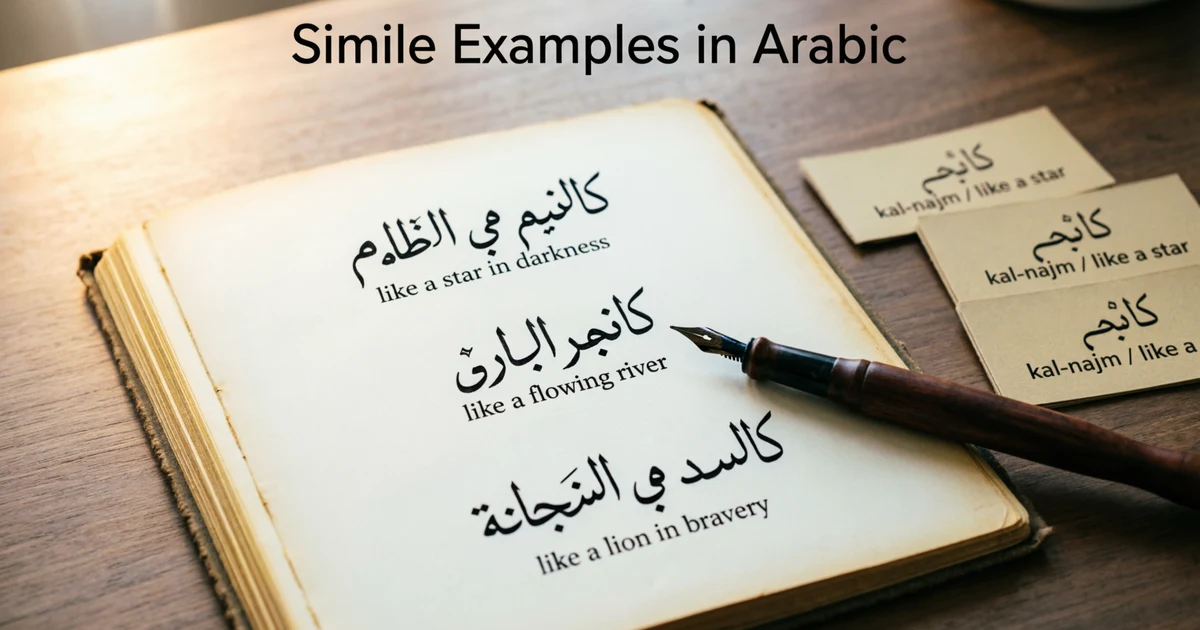
Arabic similes can make a simple sentence feel vivid, emotional, and memorable. A speaker can praise someone, describe beauty, show courage, or explain wisdom with only a few well chosen words.
In this guide, you will learn what a simile means in Arabic, how Arabic similes work, and how to understand them with English translations. You will also see simple, literary, modern, and everyday examples that students, writers, and Arabic learners can use with confidence.
What Is a Simile in Arabic
A simile in Arabic compares one thing to another to make the meaning clearer or stronger. In Arabic, this device is called tashbih.
A simile usually has four parts:
• The thing being described
• The thing it compares to
• A comparison word
• The shared quality
Example:
الطالب كالأسد في الشجاعة
Transliteration: At taalibu kal asadi fi ash shajaah
Meaning: The student is like a lion in courage.
Here, the student gets compared to a lion. The shared quality is courage.
Common Arabic comparison words include:
• كَ meaning like
• مثل meaning like or similar to
• كأن meaning as if
• يشبه meaning resembles
Simple Simile Examples in Arabic for Beginners
Beginners should start with short Arabic similes that use clear comparison words. These examples help learners see the pattern quickly.
وجهها كالقمر
Transliteration: Wajhuha kal qamar
Meaning: Her face is like the moon.
This simile shows beauty and brightness.
هو قوي كالأسد
Transliteration: Huwa qawiyyun kal asad
Meaning: He is strong like a lion.
This simile shows physical strength or bravery.
الطفل كالزهرة
Transliteration: At tiflu kaz zahrat
Meaning: The child is like a flower.
This simile suggests innocence, beauty, and softness.
العلم كالنور
Transliteration: Al ilmu kan noor
Meaning: Knowledge is like light.
This example shows how knowledge guides people.
Common Arabic Similes With English Meanings
Many Arabic similes appear in daily speech, school writing, and literature. Some sound poetic, while others feel simple and conversational.
صوته كالرعد
Transliteration: Sawtuhu kar raad
Meaning: His voice is like thunder.
This means his voice sounds very loud or powerful.
هي رقيقة كالنسيم
Transliteration: Hiya raqeeqatun kan naseem
Meaning: She is gentle like the breeze.
This shows softness and kindness.
قلبه كالحجر
Transliteration: Qalbuhu kal hajar
Meaning: His heart is like stone.
This means he shows little mercy or emotion.
ابتسامتها كالشمس
Transliteration: Ibtisamatuha kash shams
Meaning: Her smile is like the sun.
This means her smile feels warm, bright, or joyful.
Arabic Simile Examples Using Like and As
English similes often use like and as. Arabic uses different tools, but the idea stays the same.
Arabic often uses كَ before the comparison word.
سريع كالبرق
Transliteration: Sareeun kal barq
Meaning: Fast like lightning.
صابر كالجبل
Transliteration: Sabirun kal jabal
Meaning: Patient like a mountain.
Arabic also uses مثل for direct comparison.
أنت مثل النجم في الظلام
Transliteration: Anta mithlun najm fi az zalaam
Meaning: You are like a star in the dark.
Arabic uses كأن when the sentence means as if.
كأن وجهه قمر
Transliteration: Ka anna wajhahu qamar
Meaning: His face is as if it were the moon.
Beautiful Simile Examples in Arabic Literature
Arabic literature uses similes to create elegance, emotion, and visual beauty. Classical poets often used the moon, stars, swords, gardens, and seas as comparison images.
وجه الحبيب كالبدر في ليلة صافية
Transliteration: Wajhul habeebi kal badri fi laylatin saafiyah
Meaning: The beloved’s face is like the full moon on a clear night.
This simile shows beauty, purity, and brightness.
الكلمات كاللؤلؤ في حسنها
Transliteration: Al kalimaatu kal lulu fi husniha
Meaning: The words are like pearls in their beauty.
This describes elegant language.
العقل كالسراج يهدي صاحبه
Transliteration: Al aqlu kas siraaj yahdi sahibahu
Meaning: The mind is like a lamp that guides its owner.
This simile connects wisdom with light.
الشاعر كالعصفور يغني للروح
Transliteration: Ash shairu kal usfoor yughanni lir rooh
Meaning: The poet is like a bird singing to the soul.
This gives poetry a gentle and emotional image.
Everyday Arabic Similes Used in Conversation
Arabic speakers often use simple similes in normal conversation. These expressions help people describe personality, mood, speed, and behavior.
هو بارد كالثلج
Transliteration: Huwa baaridun kath thalj
Meaning: He is cold like ice.
People may use this for someone calm, emotionless, or distant.
هي نشيطة كالنحلة
Transliteration: Hiya nasheetatun kan nahlah
Meaning: She is active like a bee.
This describes a hardworking person.
يجري كالريح
Transliteration: Yajri kar reeh
Meaning: He runs like the wind.
This means he runs very fast.
ينام كالأطفال
Transliteration: Yanaamu kal atfaal
Meaning: He sleeps like children.
This suggests peaceful or deep sleep.
Arabic Similes About Beauty and Appearance
Arabic has a rich tradition of beauty based similes. Writers and speakers often compare beauty to the moon, flowers, pearls, and light.
عيناها كاللؤلؤ
Transliteration: Aynaha kal lulu
Meaning: Her eyes are like pearls.
This suggests brightness and beauty.
شعرها كالليل
Transliteration: Sharuha kal layl
Meaning: Her hair is like the night.
This usually describes dark, beautiful hair.
وجهه كالبدر
Transliteration: Wajhuhu kal badr
Meaning: His face is like the full moon.
This means the face looks bright and beautiful.
بشرتها كالحرير
Transliteration: Basharatuha kal hareer
Meaning: Her skin is like silk.
This describes smoothness and softness.
Arabic Similes About Strength and Courage
Arabic similes often use strong animals and natural images to show courage. The lion appears often because Arabic culture connects it with bravery and power.
المحارب كالأسد في المعركة
Transliteration: Al muhaaribu kal asadi fil marakah
Meaning: The warrior is like a lion in battle.
This shows courage and fearlessness.
إرادته كالحديد
Transliteration: Iraadatuhu kal hadeed
Meaning: His will is like iron.
This means he has strong determination.
وقف كالجبل أمام الخطر
Transliteration: Waqafa kal jabal amaamal khatar
Meaning: He stood like a mountain before danger.
This shows firmness and stability.
صبرها كالصخر
Transliteration: Sabruha kas sakhr
Meaning: Her patience is like rock.
This shows emotional strength.
Arabic Similes About Love and Emotion
Arabic similes can express deep feeling with grace. Love often appears through images of fire, light, gardens, and the heart.
حبه كالنار في القلب
Transliteration: Hubbuhu kan naar fil qalb
Meaning: His love is like fire in the heart.
This suggests intense passion.
قلبها كالحديقة
Transliteration: Qalbuha kal hadeeqah
Meaning: Her heart is like a garden.
This shows kindness, beauty, and warmth.
الشوق كالبحر لا ينتهي
Transliteration: Ash shawqu kal bahr la yantahi
Meaning: Longing is like the sea that never ends.
This means longing feels deep and endless.
دموعه كالمطر
Transliteration: Dumuuhu kal matar
Meaning: His tears are like rain.
This shows strong sadness or emotional release.
Arabic Similes About Wisdom and Knowledge
Arabic writers often compare wisdom and knowledge to light, lamps, treasures, and flowing water. These images show guidance, value, and clarity.
العلم كالنور يطرد الجهل
Transliteration: Al ilmu kan noor yatrudul jahl
Meaning: Knowledge is like light that drives away ignorance.
This means knowledge helps people understand life.
الحكمة كالكنز
Transliteration: Al hikmatu kal kanz
Meaning: Wisdom is like a treasure.
This shows that wisdom has great value.
المعلم كالمصباح
Transliteration: Al muallimu kal misbaah
Meaning: The teacher is like a lamp.
This means a teacher guides students.
العقل كالبوصلة
Transliteration: Al aqlu kal boosalah
Meaning: The mind is like a compass.
This shows that the mind helps a person choose the right direction.
Arabic Similes About Nature and Animals
Nature and animals give Arabic similes strong visual power. These comparisons work well because readers can imagine them quickly.
الفتاة كالوردة
Transliteration: Al fataatu kal wardah
Meaning: The girl is like a rose.
This suggests beauty and delicacy.
الرجل كالنسر في علو همته
Transliteration: Ar rajulu kan nasr fi uluwwi himmatih
Meaning: The man is like an eagle in his high ambition.
This shows ambition and dignity.
الليل كالبحر الهادئ
Transliteration: Al laylu kal bahril haadi
Meaning: The night is like a calm sea.
This gives the night a peaceful image.
الأطفال كالعصافير
Transliteration: Al atfaalu kal asaafeer
Meaning: Children are like birds.
This suggests liveliness, innocence, and movement.
Arabic Simile Examples for Students
Students can use Arabic similes in essays, stories, speeches, and language exercises. A strong simile should make the meaning clearer, not harder.
Useful student examples:
المدرسة كالبيت الثاني
Transliteration: Al madrasatu kal bayt ath thaani
Meaning: School is like a second home.
الصديق الصالح كالمرآة
Transliteration: As sadeequs saalih kal miraah
Meaning: A good friend is like a mirror.
الكتاب كالصديق الوفي
Transliteration: Al kitaabu kas sadeeqil wafi
Meaning: A book is like a loyal friend.
الوقت كالذهب
Transliteration: Al waqtu kath thahab
Meaning: Time is like gold.
Students can use these examples to discuss education, friendship, reading, and discipline.
Arabic Simile Examples for Writers
Writers need similes that feel fresh and meaningful. A good Arabic simile should match the mood of the sentence and the character’s world.
For emotional writing:
صمتها كليل طويل
Transliteration: Samtuha kalaylin taweel
Meaning: Her silence is like a long night.
For descriptive writing:
المدينة كخلية نحل في الصباح
Transliteration: Al madeenatu kakhaliyati nahl fis sabaah
Meaning: The city is like a beehive in the morning.
For reflective writing:
الذكريات كالعطر تبقى في الروح
Transliteration: Ath thikrayaat kal itr tabqa fir rooh
Meaning: Memories are like perfume that remains in the soul.
For dramatic writing:
الخوف كظل لا يفارقه
Transliteration: Al khawfu kaz zill la yufaariquh
Meaning: Fear is like a shadow that never leaves him.
Arabic Similes With Transliteration and Translation
Transliteration helps learners pronounce Arabic similes when they cannot read Arabic script fluently. Translation helps them understand meaning and use.
الحياة كرحلة طويلة
Transliteration: Al hayaatu karihlatin taweelah
Translation: Life is like a long journey.
الأمل كنجم في السماء
Transliteration: Al amalu kanajmin fis samaa
Translation: Hope is like a star in the sky.
الصبر كمفتاح الفرج
Transliteration: As sabru kamiftaahil faraj
Translation: Patience is like the key to relief.
الصداقة كشجرة مثمرة
Transliteration: As sadaaqatu kashajaratin muthmirah
Translation: Friendship is like a fruitful tree.
These examples work well in school writing because they sound clear and meaningful.
How Arabic Similes Work in Sentences
Arabic similes fit into sentences in several ways. The structure may look simple, but each word affects the tone.
Basic pattern:
Subject plus comparison word plus image
Example:
الطفل كالملاك
Meaning: The child is like an angel.
Expanded pattern:
Subject plus comparison word plus image plus shared quality
Example:
الطفل كالملاك في براءته
Meaning: The child is like an angel in his innocence.
Another pattern uses كأن:
كأن البحر مرآة صافية
Meaning: The sea is as if it were a clear mirror.
This form sounds more poetic. Writers often use it when they want a softer, more imaginative tone.
Difference Between Simile and Metaphor in Arabic
A simile compares two things directly with a comparison word. A metaphor identifies one thing as another without using a clear comparison word.
Simile example:
العلم كالنور
Meaning: Knowledge is like light.
This uses كَ, so it clearly makes a comparison.
Metaphor example:
العلم نور
Meaning: Knowledge is light.
This removes the comparison word. The sentence sounds stronger and more direct.
In Arabic, simile is tashbih. Metaphor is often called istiarah. Both create imagery, but they work differently.
A simile explains through comparison. A metaphor speaks with stronger symbolic force.
Classical Arabic Simile Examples From Poetry
Classical Arabic poetry uses simile with elegance and precision. Poets often describe the beloved, the warrior, the night, the desert, and the horse through rich comparisons.
كأن النجوم مصابيح في السماء
Transliteration: Ka annan nujooma masaabeehu fis samaa
Meaning: The stars are as if they were lamps in the sky.
This creates a bright night image.
كأن السيف برق في يد الفارس
Transliteration: Ka annas sayfa barqun fi yad al faaris
Meaning: The sword is as if it were lightning in the knight’s hand.
This shows speed and power.
كأن الخيل أمواج تجري في الصحراء
Transliteration: Ka annal khayla amwaajun tajri fis sahraa
Meaning: The horses are as if they were waves running through the desert.
This gives movement and energy to the scene.
These examples show why Arabic simile plays a major role in poetry. It turns description into a living picture.
Modern Arabic Simile Examples With Clear Meanings
Modern Arabic similes often describe city life, technology, emotions, and daily situations. They may sound less formal than classical examples, but they still create strong meaning.
الهاتف كنافذة على العالم
Transliteration: Al haatifu kanaafithatin alal aalam
Meaning: The phone is like a window to the world.
This shows how phones connect people to information.
الإنترنت كبحر واسع
Transliteration: Al internet kabahrin waasi
Meaning: The internet is like a wide sea.
This means the internet has endless information.
القلق كضيف ثقيل
Transliteration: Al qalaqu kadayfin thaqeel
Meaning: Anxiety is like a heavy guest.
This shows how anxiety can feel unwelcome and difficult.
الحياة في المدينة كسباق لا يتوقف
Transliteration: Al hayaatu fil madeenah kasibaaq la yatawaqqaf
Meaning: Life in the city is like a race that never stops.
This describes busy modern life.
Common Mistakes When Translating Arabic Similes
Arabic similes do not always translate word for word into natural English. Learners often make mistakes when they copy the Arabic structure too closely.
Common mistakes include:
• Translating every word too literally
• Ignoring the cultural image behind the simile
• Using an English phrase that sounds unnatural
• Confusing simile with metaphor
• Dropping the shared quality when the meaning needs it
Example:
وجهها كالقمر
Literal translation: Her face is like the moon.
Natural meaning: She has a bright and beautiful face.
The literal translation works, but the reader also needs the cultural meaning. In Arabic, the moon often represents beauty, brightness, and grace.
Another example:
قلبه كالحجر
Literal translation: His heart is like stone.
Natural meaning: He is hard hearted or emotionally cold.
A good translation carries both the image and the intended meaning.
How to Write Your Own Simile in Arabic
You can write a strong Arabic simile by choosing a clear image and a real shared quality. Do not choose a comparison only because it sounds beautiful. It must help the reader understand the idea.
Follow this simple method:
• Choose the subject
• Choose the quality you want to show
• Pick a clear comparison image
• Add a comparison word such as كَ, مثل, or كأن
• Read the sentence aloud to check if it sounds natural
Example process:
Subject: الوقت
Quality: value
Image: gold
Arabic simile: الوقت كالذهب
Meaning: Time is like gold.
Another example:
Subject: الأمل
Quality: guidance
Image: star
Arabic simile: الأمل كنجم في الظلام
Meaning: Hope is like a star in the dark.
The best similes feel clear, natural, and emotionally fitting.
Conclusion
Arabic similes give language color, rhythm, and emotional depth. They help speakers and writers explain beauty, courage, wisdom, love, nature, and daily life through vivid comparison.
A good Arabic simile does more than decorate a sentence. It makes the idea easier to see and feel. Once you understand words such as كَ, مثل, and كأن, you can recognize Arabic similes in conversation, literature, poetry, and student writing. With practice, you can also create your own similes in Arabic and use them with confidence.
FAQs
What does simile mean in Arabic
A simile in Arabic means tashbih. It compares one thing to another using words such as كَ, مثل, or كأن.
What is a simple simile example in Arabic
A simple example is هو قوي كالأسد, which means He is strong like a lion.
What is the Arabic word for simile
The Arabic word for simile is تشبيه, pronounced tashbih.
How do you say like in Arabic similes
Arabic often uses كَ or مثل to mean like in similes.
What does وجهها كالقمر mean
It means Her face is like the moon. The phrase usually praises beauty and brightness.
What is the difference between tashbih and istiarah
Tashbih means simile and uses comparison words. Istiarah means metaphor and makes a stronger direct comparison without a clear comparison word.
Are Arabic similes common in poetry
Yes, Arabic poetry uses similes often. Poets use them to describe beauty, bravery, nature, love, and emotion.
Can beginners use Arabic similes
Yes, beginners can use short similes such as العلم كالنور and الوقت كالذهب because they are clear and easy to understand.
What is an Arabic simile about knowledge
العلم كالنور means Knowledge is like light. It shows that knowledge guides people and removes ignorance.
How can I write a good Arabic simile
Choose a subject, choose the quality you want to show, pick a clear image, then use كَ, مثل, or كأن to connect them.