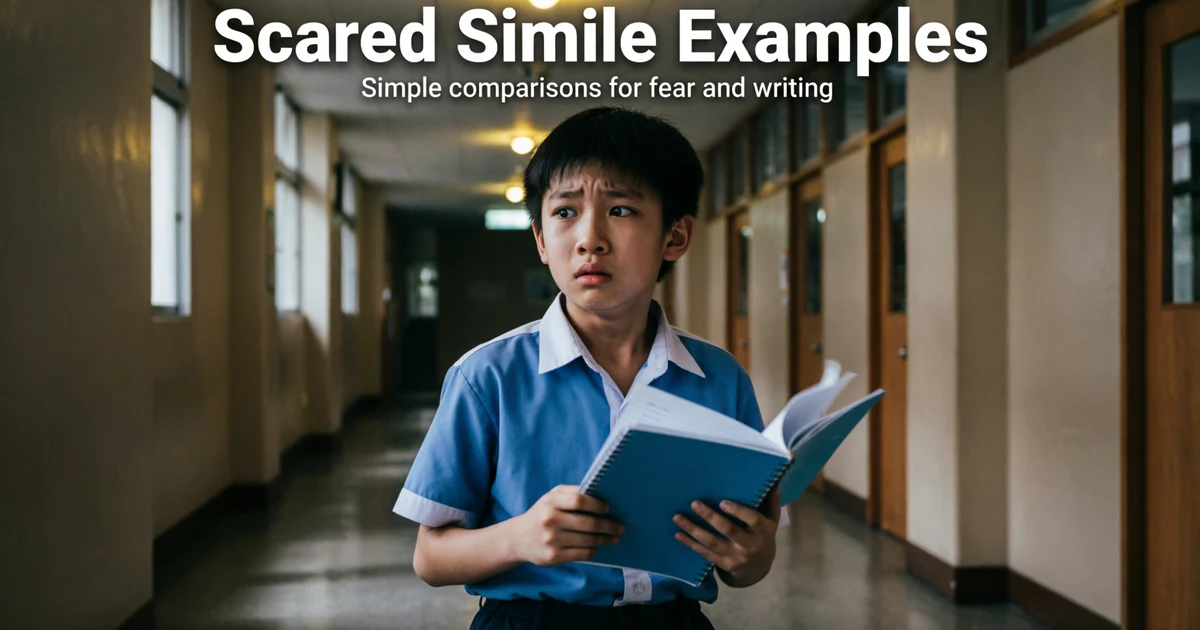
Fear can feel hard to describe. Sometimes the word scared does not show enough detail. A strong scared simile helps readers picture fear clearly. It can show a shaking body, a worried mind, a frozen face, or a sudden shock.
In this guide, you will learn what a scared simile means, how to use one naturally, and which examples work best for school writing, ESL practice, poems, stories, and creative descriptions. You will also see simple examples, stronger examples, funny examples, and common mistakes to avoid.
What a Scared Simile Means in Simple Words
A scared simile compares fear to something familiar by using like or as. It helps the reader understand how frightened someone feels.
A scared simile can describe:
- A frightened person
- A scary moment
- A nervous feeling
- A shocked reaction
- Fear in the body
- Fear in the mind
Example:
Scared as a rabbit in a storm
This means the person feels small, helpless, and nervous. The image of a rabbit makes the fear easy to imagine.
Another example:
He shook like a leaf.
This means he trembled because he felt afraid. The simile works because leaves move quickly in the wind, just like a scared body can shake.
A good scared simile does more than say someone feels afraid. It shows the kind of fear. A child hiding from thunder feels different from a person walking alone at night. Your simile should match the exact feeling.
Best Scared Simile Examples for Quick Use
Sometimes you need a scared simile quickly for a sentence, paragraph, or assignment. These examples work well because they sound clear and natural.
- Scared as a mouse near a cat
- Scared as a rabbit in a storm
- Shaking like a leaf
- Pale as a ghost
- Frozen like a statue
- Trembling like a candle flame
- Nervous as a bird in a cage
- Quiet as a child in the dark
- Jumping like a cat at thunder
- Wide eyed as an owl at midnight
These similes work for different levels of fear. Shaking like a leaf shows visible fear. Pale as a ghost shows fear on the face. Frozen like a statue shows fear that stops someone from moving.
For school writing, choose simple similes that readers understand fast. For creative writing, choose similes that fit the scene and mood.
Scared Simile Examples with Meanings
A simile becomes stronger when you understand its meaning. Here are useful scared similes with clear explanations.
Scared as a mouse near a cat
Meaning: Very afraid of danger or someone stronger.
Shaking like a leaf
Meaning: Trembling because of fear, cold, or nervousness.
Pale as a ghost
Meaning: So frightened that the face loses color.
Frozen like a statue
Meaning: Too scared to move or speak.
Scared as a deer in headlights
Meaning: Shocked and unable to react.
Trembling like a candle flame
Meaning: Shaking gently because of fear or anxiety.
Nervous as a bird in a cage
Meaning: Restless, trapped, and scared.
Silent as a shadow
Meaning: Very quiet because of fear.
Jumping like a cat at a sudden sound
Meaning: Reacting quickly because of surprise or fear.
Scared as a child lost in the dark
Meaning: Feeling alone, confused, and frightened.
Each example gives a different picture of fear. A strong writer chooses the simile that matches the exact moment.
Scared Simile Examples in Sentences
A scared simile works best when it fits naturally into a sentence. Do not place it randomly. Let it support the scene.
Examples:
She stood frozen like a statue when the door creaked open.
He was scared as a mouse near a cat when the teacher called his name.
My hands shook like leaves before I stepped onto the stage.
The little boy looked pale as a ghost after hearing the loud crash.
She jumped like a cat at thunder when the window slammed shut.
He waited in the hallway, nervous as a bird in a cage.
Her voice trembled like a candle flame in the dark room.
The puppy hid under the bed, scared as a rabbit in a storm.
His eyes grew wide as an owl at midnight.
The child stayed quiet as a shadow during the scary story.
Notice how each sentence gives context. The simile does not stand alone. It connects to a person, place, action, or feeling.
Simple Scared Similes for Students
Students often need scared similes for essays, stories, worksheets, or classroom activities. Simple similes work best because they sound clear and easy to explain.
Useful student examples:
- Scared as a rabbit
- Scared as a mouse
- Shaking like a leaf
- Pale as a ghost
- Frozen like ice
- Quiet as a shadow
- Nervous as a bird
- Jumping like a cat
Student sentence examples:
I was scared as a rabbit when I heard footsteps behind me.
My brother shook like a leaf during the storm.
She looked pale as a ghost after the loud bang.
I froze like ice when the lights went out.
The best student similes use common images. A teacher can easily see the comparison, and the sentence stays clear.
Easy Scared Similes for ESL Learners
ESL learners need scared similes that use simple vocabulary and clear meaning. Avoid complex images at first. Start with familiar animals, body actions, and daily situations.
Easy scared similes:
- Scared as a mouse
- Shaking like a leaf
- Pale as a ghost
- Frozen like ice
- Quiet as a shadow
- Nervous as a bird
- Jumping like a cat
- Trembling like a small flame
Simple ESL sentences:
I was scared as a mouse.
She shook like a leaf.
He looked pale as a ghost.
They froze like ice.
The child was quiet as a shadow.
To use these correctly, remember the pattern:
As scared as a mouse
Shaking like a leaf
Frozen like ice
These forms sound natural in English and help learners describe fear with more detail.
Scared Similes for Kids and Beginners
Kids need scared similes that feel simple, visual, and easy to remember. Animal similes often work well because children understand animal behavior.
Examples for kids:
- Scared as a kitten in the rain
- Scared as a puppy during thunder
- Scared as a mouse near a cat
- Shaking like jelly
- Hiding like a turtle in its shell
- Jumping like a frog at a splash
- Quiet as a sleeping mouse
- Wide eyed as an owl
Kid friendly sentences:
The kitten was scared as a puppy during thunder.
I hid like a turtle in its shell when the lights went out.
Ben shook like jelly after the scary movie.
Mia jumped like a frog when the balloon popped.
These similes help children connect fear with clear pictures. They also make writing more fun and expressive.
Scared Similes for Creative Writing
Creative writing needs similes that create mood, not just meaning. A basic simile can describe fear, but a creative simile can make readers feel it.
Creative scared similes:
- Her fear spread like ink in water.
- His courage faded like a match in the rain.
- She trembled like a candle in a cold room.
- His heart beat like a drum in an empty hall.
- Fear crawled over him like spiders on skin.
- She stood still like a statue carved from worry.
- His voice cracked like thin ice.
- Her breath came fast like wings trapped in a box.
These examples work because they add sensory detail. They show sound, movement, touch, and atmosphere.
For creative writing, ask yourself:
- What does the fear look like?
- What does the fear sound like?
- What does the body do?
- What image matches the scene?
A haunted house needs a different simile than a school speech. Match the comparison to the setting.
Scared Similes for Story Writing
Stories need scared similes that support character, action, and mood. The simile should help readers understand what the character feels in that moment.
Examples for story writing:
- Liam froze like a statue when the basement door opened.
- Her hands shook like leaves as she held the old key.
- The dog hid like a turtle in its shell during the fireworks.
- He stared at the shadow, wide eyed as an owl.
- Fear moved through the room like cold air under a door.
- She backed away like a mouse from a sleeping cat.
- His heartbeat pounded like boots on wooden stairs.
A story simile should not stop the action. It should make the action sharper.
Weak sentence:
He was very scared.
Stronger sentence:
He shook like a leaf as the footsteps came closer.
The second sentence gives movement, fear, and suspense. It helps the reader enter the scene.
Scared Similes for Descriptive Paragraphs
A descriptive paragraph needs more detail than a single sentence. You can use one or two scared similes, but do not overload the paragraph.
Example paragraph:
The hallway felt colder than before. Maya stood frozen like a statue, her fingers tight around the flashlight. A sound scratched behind the wall, and her breath trembled like a candle flame. She wanted to run, but her feet would not move.
This paragraph uses two scared similes. Frozen like a statue shows her body. Trembled like a candle flame shows her breath. Together, they build fear without repeating the same idea.
Another example:
The boy looked pale as a ghost when the thunder cracked above the house. He pulled the blanket to his chin and hid like a turtle in its shell. Every shadow on the wall seemed to move.
This paragraph works well for younger readers because the images stay simple and clear.
Scared Similes for Poems and Emotional Writing
Poems often use scared similes to show fear in a softer or deeper way. Emotional writing can describe fear as quiet, heavy, sharp, or cold.
Poetic scared similes:
- Fear sat in my chest like a stone.
- My heart fluttered like a trapped bird.
- I felt small as a candle in a storm.
- My thoughts scattered like birds from a tree.
- My voice faded like smoke in the dark.
- I shook like rain on a window.
- My courage cracked like dry earth.
- The night pressed around me like a heavy coat.
These similes work well because they connect fear to emotion. They do not only show panic. They also show loneliness, worry, and weakness.
In poems, use scared similes with care. One strong image can create more feeling than a long list of comparisons.
Scared Similes for Describing a Frightened Person
When you describe a frightened person, focus on face, body, voice, and movement. A scared simile should show what fear does to the person.
Examples:
- She looked pale as a ghost.
- He shook like a leaf.
- Her eyes widened like an owl in the dark.
- He stood frozen like a statue.
- Her lips trembled like a candle flame.
- He moved like a mouse trying not to wake a cat.
- She curled up like a turtle in its shell.
- His voice cracked like thin glass.
You can also combine a simile with a physical detail.
Example:
His hands shook like leaves, and his voice dropped to a whisper.
This gives the reader two signs of fear. The hands show nervous movement. The voice shows emotional pressure.
Scared Similes for Describing Fear in the Body
Fear often shows through the body before a person speaks. Writers can describe shaking, sweating, breath, heartbeat, eyes, and muscles.
Useful body focused similes:
- My heart beat like a drum.
- My knees shook like loose sticks.
- My hands trembled like leaves.
- My throat tightened like a closed fist.
- My breath came fast like a trapped bird.
- My skin prickled like cold rain.
- My legs felt weak as wet paper.
- My stomach twisted like a knot.
Sentence examples:
My heart beat like a drum when I heard the scream.
Her knees shook like loose sticks before she entered the room.
His breath came fast like a trapped bird.
My stomach twisted like a knot as the shadow moved closer.
Body based similes help readers feel fear physically. They make the scene more believable.
Scared Similes for Describing a Scary Moment
A scary moment needs atmosphere. The simile should match the sound, light, setting, or sudden action.
Examples:
- The room went silent as a graveyard.
- The shadow moved like smoke across the wall.
- The wind cried like a lost child.
- The door creaked like an old warning.
- The darkness wrapped around us like a thick blanket.
- The scream cut through the air like broken glass.
- The house stood still like it was holding its breath.
- The footsteps came closer like a ticking clock.
Sentence examples:
The darkness wrapped around us like a thick blanket.
The scream cut through the air like broken glass.
The house stood still like it was holding its breath.
These similes describe more than the person. They make the whole moment feel frightening.
Scared Similes for Horror and Suspense Writing
Horror and suspense need sharper images. The best similes build tension and make readers expect danger.
Examples:
- Fear crawled up his spine like a spider.
- Her heartbeat hammered like fists on a locked door.
- The silence stretched like a dark tunnel.
- His breath shook like a dying flame.
- The shadow bent toward him like a hungry animal.
- The floor groaned like something waking up.
- Her courage broke like glass under a boot.
- The cold touched his neck like icy fingers.
Horror similes should feel specific. Avoid plain comparisons when the scene needs tension.
Weak horror line:
She was scared like a child.
Stronger horror line:
Her breath shook like a dying flame as the closet door opened.
The stronger line adds mood, movement, and danger.
Scared Similes for Anxiety and Nervousness
Not all fear comes from danger. Sometimes a person feels scared because of worry, pressure, embarrassment, or uncertainty. Anxiety similes should feel restless and tense.
Examples:
- Nervous as a bird in a cage
- My thoughts raced like mice in the walls.
- My heart fluttered like trapped wings.
- My hands felt cold as stone.
- My stomach twisted like a tight knot.
- I felt small as a child in a crowded room.
- My voice shook like paper in the wind.
- Worry buzzed in my head like bees.
Sentence examples:
Before the exam, my thoughts raced like mice in the walls.
Her voice shook like paper in the wind during the speech.
Worry buzzed in my head like bees all morning.
These similes work well for school, personal writing, and emotional scenes. They describe fear without needing a monster, storm, or chase.
Scared Similes for Shock and Surprise
Shock happens fast. A scared simile for shock should show sudden movement, frozen reaction, wide eyes, or a quick jump.
Examples:
- He jumped like a cat at thunder.
- She froze like ice.
- His eyes opened wide as an owl.
- I stood still like a statue.
- She gasped like a fish out of water.
- He sprang back like a rubber band.
- My heart leapt like a startled deer.
- They scattered like birds from a tree.
Sentence examples:
He jumped like a cat at thunder when the alarm rang.
She froze like ice after hearing the news.
The children scattered like birds from a tree when the dog barked.
These similes show instant fear. They work best when something sudden happens.
Funny Scared Similes That Still Make Sense
Funny scared similes can make writing playful, but they still need clear meaning. Use them in light stories, casual writing, cartoons, or humorous descriptions.
Examples:
- Scared as a cat in a room full of rocking chairs
- Shaking like jelly on a plate
- Jumping like popcorn in a hot pan
- Hiding like a sock in a laundry basket
- Pale as milk in a glass
- Running like a chicken from a garden hose
- Screaming like a kettle on the stove
- Nervous as a squirrel at a dog show
Sentence examples:
He was shaking like jelly on a plate before the school play.
Mina jumped like popcorn in a hot pan when the balloon burst.
The puppy ran like a chicken from a garden hose.
Funny similes should fit the tone. Do not use them in serious grief, danger, or horror scenes unless you want a comic effect.
How to Use Scared Similes Naturally
A scared simile sounds natural when it fits the scene, character, and level of fear. Do not choose the most dramatic image every time. A small fear needs a simple simile. A terrifying moment needs a stronger one.
Use these tips:
- Match the simile to the emotion
- Keep the image clear
- Avoid too many similes in one paragraph
- Choose familiar images for students and ESL readers
- Use stronger images for stories and poems
- Place the simile near an action or detail
Natural example:
Her hands shook like leaves as she reached for the door.
Unnatural example:
Her hands shook like leaves and her fear was like a storm and her face was like a ghost.
The second sentence uses too many comparisons. It feels crowded. One clear simile usually works better.
Common Mistakes to Avoid with Scared Similes
Many writers weaken scared similes by choosing unclear, overused, or mismatched comparisons. You can avoid these mistakes with careful choices.
Common mistakes:
- Using a simile that does not match the scene
- Adding too many similes in one paragraph
- Choosing a comparison that readers cannot picture
- Mixing funny similes with serious fear
- Repeating the same simile many times
- Using vague lines like scared like something bad
- Forgetting to show body language or action
Weak example:
He was scared like a thing.
Better example:
He shook like a leaf when the lights went out.
Weak example:
She was scared as a lion.
Better example:
She was scared as a mouse near a cat.
A lion usually suggests strength, not fear. A mouse near a cat gives a clearer picture.
Conclusion
A scared simile helps writers describe fear in a clear and memorable way. It can show a shaking body, a pale face, a frozen reaction, a racing heart, or a nervous mind. The best simile always fits the scene.
For simple writing, use clear examples like scared as a mouse, shaking like a leaf, or pale as a ghost. For creative writing, choose deeper images like fear spread like ink in water or his voice cracked like thin ice. When you match the simile to the feeling, your writing becomes stronger, clearer, and more vivid.
FAQs
What is a scared simile?
A scared simile compares fear to something familiar using like or as. For example, scared as a mouse near a cat shows strong fear clearly.
What is a simple simile for scared?
A simple simile for scared is shaking like a leaf. It means a person trembles because they feel afraid or nervous.
Is scared as a mouse a simile?
Yes, scared as a mouse is a simile. It compares a frightened person to a small mouse near danger.
What is a good scared simile for students?
A good scared simile for students is pale as a ghost. It clearly shows that someone looks frightened.
What is a scared simile for creative writing?
A strong creative simile is fear crawled up his spine like a spider. It creates a tense and scary feeling.
What is a scared simile for kids?
A good scared simile for kids is scared as a puppy during thunder. It uses a simple image that children can understand.
What is a scared simile for horror writing?
A strong horror simile is the silence stretched like a dark tunnel. It builds suspense and makes the scene feel dangerous.
What is a scared simile for anxiety?
A useful anxiety simile is my thoughts raced like mice in the walls. It shows nervous, restless thinking.
How do I use scared similes in a sentence?
Place the simile near the action. For example, she shook like a leaf when the door opened.
What mistake should I avoid with scared similes?
Do not use too many scared similes in one paragraph. One clear comparison often creates a stronger effect than several crowded images.