Quick Answer
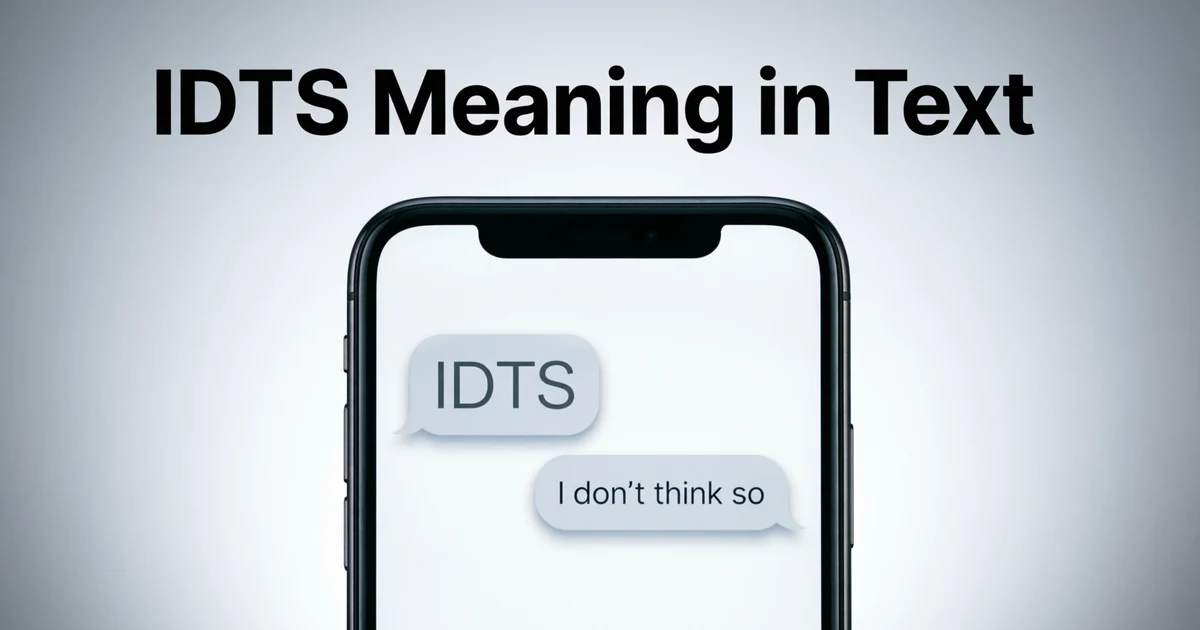
IDTS means I don’t think so in text messages and online conversations. People use it to express doubt, disagreement, uncertainty, or a polite refusal without typing the full phrase.
For example, if someone asks, Are you going to the party tonight? you might reply, IDTS, I have too much work. The exact tone depends on the conversation. It may sound uncertain, casual, dismissive, playful, or slightly annoyed.
Introduction
Seeing IDTS in a message can be confusing, especially when the sender gives no other explanation. It is not as widely recognized as common abbreviations such as IDK, LOL, or TBH, so many readers search for the IDTS meaning in text after finding it in a private message, group chat, comment, or social media reply.
In most casual conversations, IDTS is simply a shortened version of I don’t think so. A person may use it when they believe something is unlikely, disagree with a statement, want to decline an invitation, or do not have enough information to give a definite answer. The meaning usually stays the same, but punctuation, emojis, and context can change how the response feels.
This guide explains what IDTS means, how people use it, how to interpret its tone, and how it differs from similar texting abbreviations. You will also find realistic examples, common mistakes, and appropriate ways to respond when someone sends IDTS.
| Term | Meaning | Tone | Example |
|---|---|---|---|
| IDTS | I don’t think so | Doubtful or negative | IDTS, the store is already closed |
| IDK | I don’t know | Uncertain | IDK what time it starts |
| IDC | I don’t care | Indifferent | IDC where we eat |
| IMO | In my opinion | Opinion based | IMO, the first option is better |
| TBH | To be honest | Direct or sincere | TBH, I did not enjoy it |
| Probably not | Something is unlikely | Neutral | Probably not, but I will check |
What Does IDTS Mean in Text?
IDTS stands for I don’t think so. It is an internet initialism commonly used in texting, messaging apps, online chats, and social media conversations.
The phrase usually communicates that the sender believes the answer is no, but it can be softer than giving a direct no. It may suggest uncertainty rather than complete confidence.
For example:
Person 1: Is the assignment due today?
Person 2: IDTS. I think it is due Friday.
In this conversation, the second person believes the assignment is not due today but is not completely certain.
IDTS can also express disagreement:
Person 1: This is the best movie in the series.
Person 2: IDTS. The second one was better.
Here, IDTS means the sender does not agree with the statement.
In other situations, it can work as a casual refusal:
Person 1: Are you coming out tonight?
Person 2: IDTS, I am exhausted.
The basic meaning remains I don’t think so, but the reason and emotional tone depend on the rest of the message.
How IDTS Is Used in Conversations
People usually use IDTS when they want to answer quickly without writing a complete sentence. It works best in informal conversations with friends, classmates, relatives, or people who understand common internet slang.
To Express Uncertainty
IDTS can show that the sender believes something is unlikely but does not know for certain.
Example:
Do you think the package will arrive today?
IDTS. The tracking page still says processing.
The person expects that it will not arrive, but the response leaves room for the possibility that it might.
To Disagree With Someone
The abbreviation may be used when someone questions another person’s opinion, assumption, or claim.
Example:
You definitely liked that restaurant.
IDTS. The service was good, but the food was average.
The response communicates disagreement without sounding as strong as You are wrong.
To Decline an Invitation
Someone may use IDTS when they probably cannot attend an event or participate in a plan.
Example:
Are you joining us for dinner?
IDTS, I still have a lot of work to finish.
In this situation, IDTS functions as a soft no.
To Challenge a Claim
IDTS may also appear as a short reaction when someone finds a statement hard to believe.
Example:
He said he finished the whole project in one hour.
IDTS. That would take much longer.
The sender doubts the accuracy of the claim.
IDTS Meaning on Social Media
On TikTok, Instagram, Snapchat, Facebook, X, and other platforms, IDTS still normally means I don’t think so. People may use it in comments, captions, replies, private messages, and group conversations.
For example:
Comment: This trend will still be popular next year.
Reply: IDTS, people are already moving on.
In social media comments, short responses can sound stronger because they lack facial expressions and vocal tone. An IDTS reply by itself may appear dismissive, even when the sender only intended to express uncertainty.
Adding a reason can make the meaning clearer:
IDTS because the company already announced a different plan.
Emojis can also affect the tone:
IDTS 😂
This may sound playful or amused.
IDTS 😬
This may suggest discomfort or doubt.
IDTS 🙄
This can sound annoyed, sarcastic, or dismissive.
What Tone Does IDTS Have?
IDTS does not carry one fixed emotion. Its tone depends on punctuation, wording, the relationship between the people, and the topic being discussed.
| Message | Likely Tone | Meaning |
|---|---|---|
| IDTS | Direct or uncertain | I do not believe so |
| idts lol | Playful | I doubt it, but I am joking |
| IDTS, sorry | Polite refusal | I probably cannot do that |
| IDTS!!! | Strong disagreement | I definitely do not agree |
| idts 😭 | Humorous disappointment | Probably not, unfortunately |
| IDTS. | Firm or serious | No, I do not think that is true |
| Hmm, idts | Thoughtful uncertainty | I am not convinced |
A lowercase idts often feels casual. Capital letters may simply be the person’s typing style, but they can sometimes make the response appear more forceful.
A period can also affect interpretation. IDTS. may sound final or irritated, while idts lol can feel relaxed and friendly.
Examples of IDTS in Text Messages
Here are natural examples showing how IDTS can appear in different conversations.
Making Plans
Person 1: Do you think everyone can meet Saturday?
Person 2: IDTS. Mia said she has to work.
School or College
Person 1: Is the test open book?
Person 2: IDTS, but you should check the course page.
Workplace Chat
Person 1: Will the report be approved today?
Person 2: IDTS. The manager is still reviewing it.
IDTS may appear in casual workplace chat, but it is better to write the full phrase in formal emails or client communication.
Shopping
Person 1: Do you think this laptop will go on sale soon?
Person 2: IDTS. It was already discounted last week.
Entertainment
Person 1: Is that show getting another season?
Person 2: IDTS, the final episode wrapped up the whole story.
Relationships
Person 1: Do you think she is still upset?
Person 2: IDTS. She seemed fine when I talked to her.
Family Conversation
Person 1: Is Dad home yet?
Person 2: IDTS. His car is not outside.
Social Media
Person 1: That video has to be staged.
Person 2: IDTS, the reaction looked real to me.
IDTS From a Girl or Guy
IDTS has the same basic meaning regardless of who sends it. From a girl or a guy, it normally means I don’t think so.
The more important clues are the surrounding message, the relationship, and the question being answered.
For example:
Do you like him?
IDTS.
This may mean the person is uncertain about their feelings or is gently saying no.
Do you want to go out this weekend?
IDTS, I am busy.
This usually means the person probably cannot or does not want to go. However, one response alone may not explain the reason.
Do not assume IDTS automatically signals anger, rejection, or loss of interest. Look at the full conversation before drawing a conclusion.
How to Respond to IDTS
The best response depends on whether the sender is uncertain, disagreeing, or declining something.
You can ask for clarification:
What makes you think that?
Are you unsure, or is that a no?
Do you know when you will decide?
You can accept the response politely:
No problem.
Okay, thanks for letting me know.
That makes sense.
You can also provide more information if the person is questioning a fact:
I checked the schedule, and it says the event starts at seven.
Avoid pressuring someone when IDTS is being used as a polite refusal. Give them space to explain only if clarification is genuinely necessary.
IDTS Compared With Similar Texting Terms
Several abbreviations can look or sound similar to IDTS, but they communicate different ideas.
| Term | Meaning | Best Use | Example |
|---|---|---|---|
| IDTS | I don’t think so | Expressing doubt or a likely no | IDTS, it is too late |
| IDK | I don’t know | Lacking information | IDK when she will arrive |
| IDRK | I don’t really know | Stronger uncertainty | IDRK what happened |
| IDC | I don’t care | Showing indifference | IDC which movie we watch |
| IKR | I know, right? | Showing agreement | IKR, that was surprising |
| IMO | In my opinion | Sharing a personal view | IMO, the blue one looks better |
| NGL | Not gonna lie | Introducing an honest opinion | NGL, I expected more |
| TBH | To be honest | Speaking directly | TBH, I would choose another option |
The most common mistake is confusing IDTS with IDK. IDTS suggests that the sender has an opinion and believes the answer is probably no. IDK means the sender does not know the answer.
When Should You Use IDTS?
IDTS works well in casual digital conversations where short forms feel natural.
You can use it when:
- You believe something is unlikely
- You disagree with a statement
- You want to give a soft no
- You are uncertain but lean toward a negative answer
- You are replying quickly in a casual chat
You should avoid it in situations where clarity and professionalism matter. Formal emails, academic assignments, customer support responses, legal documents, and official workplace communication usually require complete wording.
Instead of writing:
IDTS the payment has been processed.
Write:
I don’t think the payment has been processed yet.
The complete sentence is clearer and reduces the risk of misunderstanding.
Common Mistakes With IDTS
Assuming It Always Means a Definite No
IDTS often means probably not rather than absolutely not. The sender may still be uncertain.
Reading Too Much Emotion Into It
A short reply can look cold, but the sender may simply be typing quickly. Do not assume anger or disrespect without considering the wider conversation.
Confusing IDTS With IDK
IDTS expresses an opinion or belief. IDK communicates a lack of knowledge.
Using It in Formal Communication
Not every reader understands texting abbreviations. Writing the complete phrase is safer in professional or important conversations.
Ignoring the Rest of the Message
Context determines whether IDTS expresses doubt, disagreement, humor, or refusal. Read the messages before and after it before deciding what the person intended.
Assuming It Has a Different Meaning on Every Platform
The meaning generally remains I don’t think so across texting apps and social platforms. The tone may change, but the full form usually does not.
Is IDTS Rude?
IDTS is not automatically rude. It can be a normal, casual way to express doubt or say no. However, a one word reply may feel abrupt in sensitive conversations.
Compare these examples:
IDTS.
IDTS, but I appreciate you asking.
The second response sounds warmer because it includes context and appreciation.
When discussing something personal, serious, or emotional, writing the full phrase and adding an explanation can prevent the message from sounding dismissive.
Conclusion
The IDTS meaning in text is I don’t think so. People use it to express doubt, disagreement, uncertainty, or a polite refusal in messages and social media conversations.
The words around it, punctuation, and emojis help reveal the intended tone. IDTS may mean probably not, I disagree, or I am not convinced. When the situation is formal or sensitive, writing the complete phrase is usually clearer and more respectful.
Frequently Asked Questions
What does IDTS mean in text messages?
IDTS means I don’t think so. It is commonly used when someone believes the answer is probably no or disagrees with a statement.
What does IDTS stand for on social media?
On social media, IDTS usually stands for I don’t think so. It may appear in comments, direct messages, captions, and group chats.
Is IDTS the same as IDK?
No. IDTS means I don’t think so, while IDK means I don’t know. IDTS expresses a belief or opinion, while IDK shows that the person lacks information.
Is IDTS a rejection?
It can be. When used in response to an invitation or request, IDTS may function as a soft rejection. However, it can also express uncertainty rather than a definite no.
What does IDTS mean from a girl?
It normally means I don’t think so. Her exact intention depends on the question, the surrounding conversation, and the tone of the message.
What does IDTS mean from a guy?
It usually means I don’t think so. It may communicate disagreement, doubt, uncertainty, or a casual refusal.
Is IDTS rude in texting?
Not necessarily. It is a casual abbreviation, but sending it alone may sound blunt in a serious conversation. Adding a reason can make the response feel friendlier.
Should IDTS be written in uppercase or lowercase?
Both IDTS and idts have the same meaning. Lowercase often looks more casual, while uppercase may appear stronger depending on the conversation.