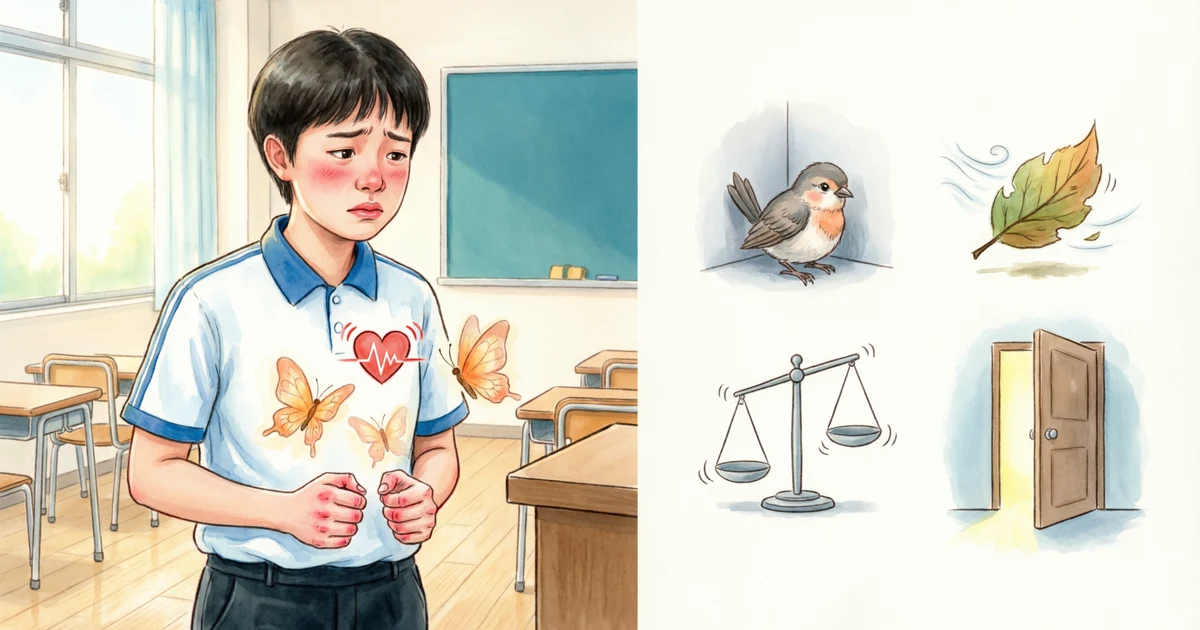
Anxiety can feel difficult to describe. A person may feel worried, tense, restless, frightened, or uncertain, but none of these single words always captures the full experience. This is why English speakers often use idioms for anxiety, such as “butterflies in my stomach” or “on pins and needles.”
Anxiety idioms describe nervous feelings through vivid, figurative images. Anxiety synonyms, by contrast, name those feelings more directly. For example, “I am anxious about the interview” gives a clear description, while “I have butterflies in my stomach” creates a picture of the physical nervousness someone may feel before the interview.
The main difference is simple:
Anxiety idioms express worry or nervousness figuratively, while anxiety synonyms describe the feeling directly.
Both can communicate similar emotions, but they serve different purposes. Idioms often make speech and creative writing more expressive. Synonyms usually provide greater precision and work better in formal, academic, or factual writing.
This guide explains how anxiety idioms and anxiety synonyms work, where they overlap, and how students, writers, and ESL learners can use them naturally.
What Idioms for Anxiety Mean
An idiom for anxiety is a fixed expression that describes worry, fear, tension, or nervous anticipation without stating the emotion literally.
The meaning of an idiom usually cannot be understood by examining each word separately. For example, “on pins and needles” does not mean that someone is physically standing on sharp objects. It means that the person feels extremely nervous, excited, or impatient while waiting for something.
Simple definition
Anxiety idioms are figurative expressions used to describe nervousness, worry, fear, or emotional tension.
Purpose
Their purpose is to make a feeling more vivid, relatable, or memorable.
How they work
They connect an emotional experience with a familiar physical image, action, or situation.
Short example
I had butterflies in my stomach before the exam.
The speaker does not literally have butterflies inside the body. The expression describes a nervous, fluttering sensation.
Why anxiety idioms get confused with synonyms
Idioms and synonyms can communicate the same general emotion. However, an idiom creates an indirect image, while a synonym directly names the feeling.
What Anxiety Synonyms Mean
An anxiety synonym is a word or short phrase with a meaning similar to anxiety. Common examples include worry, nervousness, unease, apprehension, tension, distress, and fear.
These words do not always mean exactly the same thing. Each one expresses a slightly different type or level of anxious feeling.
For example:
- Unease suggests mild discomfort or uncertainty.
- Apprehension often refers to worry about something that may happen.
- Nervousness commonly describes tension before an event.
- Distress suggests stronger emotional suffering.
- Panic describes sudden and intense fear.
Simple definition
Anxiety synonyms are direct words that describe worry, fear, nervousness, or emotional discomfort.
Purpose
Their purpose is to identify an emotion clearly and precisely.
How they work
They replace or refine the word “anxiety” according to the situation, intensity, and tone.
Short example
She felt apprehensive about speaking in front of the class.
“Apprehensive” directly describes her worried expectation.
Why anxiety synonyms get confused with idioms
Both may fit the same situation. A learner might say either “She felt nervous” or “She had butterflies in her stomach.” The first uses a direct word, while the second uses an idiom.
Idioms for Anxiety vs Anxiety Synonyms: The Core Difference
The core difference lies in how the meaning is expressed.
Anxiety idioms communicate meaning indirectly through figurative language. Anxiety synonyms communicate it directly through specific vocabulary.
Consider these two sentences:
Daniel felt nervous before the competition.
Daniel was a bundle of nerves before the competition.
Both sentences describe anxiety. However, “nervous” names the emotion directly, while “a bundle of nerves” paints a more vivid picture of Daniel’s tense condition.
Idioms usually add personality, imagery, and conversational warmth. Synonyms usually add clarity, accuracy, and control over emotional intensity.
Anxiety synonyms form the broader vocabulary category because they include many direct words for different shades of worry. Anxiety idioms form a narrower category of fixed figurative expressions.
Quick Comparison Table
| Point | Idioms for Anxiety | Anxiety Synonyms |
|---|---|---|
| Definition | Figurative expressions that describe worry or nervousness | Direct words with meanings related to anxiety |
| Scope | Narrower category of fixed expressions | Broader vocabulary category |
| Purpose | To create imagery and emotional impact | To communicate feelings clearly and precisely |
| Length | Usually several words | Usually one word or a short phrase |
| Structure | Often fixed and cannot be freely changed | Can change form according to grammar |
| Meaning | Indirect or nonliteral | Mostly direct and literal |
| Use in writing | Conversation, fiction, dialogue, blogs, and informal writing | Formal, academic, professional, and creative writing |
| Example | “She was on edge.” | “She was anxious.” |
How Idioms for Anxiety Work
Idioms work by connecting an invisible emotion to something readers can imagine.
Anxiety often produces physical reactions. A person may experience a fast heartbeat, trembling hands, sweating, stomach discomfort, or difficulty remaining still. Many anxiety idioms draw on these physical experiences.
For example:
- “My heart was in my mouth” connects fear with a pounding heartbeat.
- “I was shaking like a leaf” compares trembling to a leaf moving in the wind.
- “I was on edge” suggests a person who feels unable to relax.
- “I was sweating bullets” exaggerates heavy sweating caused by fear or pressure.
Other anxiety idioms focus on waiting and uncertainty:
- “On pins and needles”
- “Waiting with bated breath”
- “The suspense was killing me”
These expressions do more than report an emotion. They help the reader experience the situation through imagery.
Idioms also depend heavily on context. The expression “butterflies in my stomach” may describe anxiety, excitement, romantic attraction, or a mixture of these feelings. The surrounding sentence helps readers understand the intended meaning.
How Anxiety Synonyms Work
Anxiety synonyms allow speakers and writers to select the exact shade of emotion they want to communicate.
The word “anxiety” covers a wide range of experiences, from mild concern to overwhelming fear. A more specific synonym can make the meaning clearer.
Consider these examples:
Maya felt uneasy when she heard footsteps outside.
Maya felt terrified when someone tried to open the door.
“Uneasy” expresses mild discomfort. “Terrified” expresses intense fear. Using the correct word helps the reader understand the strength and nature of the emotion.
Synonyms also change according to grammar:
- Anxiety is a noun.
- Anxious is an adjective.
- Anxiously is an adverb.
- Worry can function as a noun or verb.
- Worried can function as an adjective.
This flexibility makes synonyms useful in many kinds of sentences.
Writers should still choose carefully. Two words may be related without being completely interchangeable. “Stress,” “fear,” and “anxiety,” for instance, overlap, but they do not always describe the same experience.
Key Differences in Simple Language
Anxiety idioms and anxiety synonyms differ in several important ways.
Idioms are figurative
An idiom says something imaginative rather than literal.
I was a nervous wreck.
The speaker is not a damaged vehicle or object. The phrase means that the speaker felt extremely nervous.
Synonyms are direct
A synonym names the emotion.
I was extremely anxious.
This sentence communicates the feeling without figurative imagery.
Idioms usually contain several words
Most idioms appear as phrases:
- On edge
- A bundle of nerves
- Sick with worry
- Shaking like a leaf
Synonyms are usually individual words:
- Nervous
- Worried
- Uneasy
- Apprehensive
Idioms have fixed wording
English speakers normally say “butterflies in my stomach,” not “moths in my stomach.” Changing the main image can destroy the recognized idiomatic meaning.
Synonyms allow more grammatical variation:
- worry
- worried
- worrying
- worries
Idioms often sound conversational
They commonly appear in everyday speech, stories, dialogue, personal essays, and informal articles.
Synonyms work in both informal and formal contexts, depending on the selected word.
Can Idioms for Anxiety and Anxiety Synonyms Overlap?
Yes. They often overlap because they describe similar emotional states.
A person waiting for medical results might say:
I am anxious about the results.
The same person might also say:
I am on pins and needles waiting for the results.
Both sentences communicate nervous anticipation. However, they create different effects.
The first sentence sounds direct and neutral. The second sounds more expressive and emphasizes the discomfort of waiting.
An idiom can often be replaced by a synonym without changing the basic message:
- “He was on edge” becomes “He was tense.”
- “She was worried sick” becomes “She was extremely worried.”
- “I had butterflies in my stomach” becomes “I felt nervous.”
However, the replacement may lose imagery, emotion, or conversational personality.
The reverse is also true. Replacing every direct anxiety word with an idiom can make writing feel exaggerated or unnatural. Strong writing usually balances both.
Examples of Idioms for Anxiety
The following idioms describe different forms of anxiety, from mild nervousness to intense fear.
1. Butterflies in your stomach
Meaning: To feel nervous, often before an important or exciting event.
I had butterflies in my stomach before my first driving lesson.
This idiom often describes mild anxiety mixed with anticipation.
2. On edge
Meaning: Nervous, tense, or unable to relax.
Everyone felt on edge during the storm.
This expression works well for ongoing tension.
3. A bundle of nerves
Meaning: A person who feels extremely nervous.
Liam was a bundle of nerves before the job interview.
It emphasizes a visible or intense state of nervousness.
4. On pins and needles
Meaning: Nervously waiting for something to happen.
We were on pins and needles while the judges announced the winner.
This idiom often combines nervousness with expectation.
5. Worried sick
Meaning: Extremely worried about someone or something.
Her parents were worried sick when she did not answer her phone.
The word “sick” intensifies the feeling. It does not always mean actual illness.
6. My heart was in my mouth
Meaning: To feel suddenly frightened or extremely nervous.
My heart was in my mouth when the car started sliding.
This idiom describes an immediate moment of fear.
7. Shaking like a leaf
Meaning: Trembling because of fear or nervousness.
He was shaking like a leaf before walking onto the stage.
The comparison creates a clear visual image.
8. Sweating bullets
Meaning: Sweating heavily because of fear, pressure, or anxiety.
I was sweating bullets while waiting for the teacher to check my answer.
This informal idiom uses exaggeration for effect.
9. Sick with worry
Meaning: So worried that the feeling causes physical discomfort.
She felt sick with worry while her dog was missing.
This phrase often communicates serious concern rather than ordinary nervousness.
10. A nervous wreck
Meaning: Someone who feels extremely nervous, upset, or emotionally exhausted.
I was a nervous wreck during the final minutes of the match.
The expression sounds strong and should not describe mild concern.
11. Have your stomach in knots
Meaning: To feel strong tension or anxiety in your stomach.
My stomach was in knots before I opened the email.
This idiom highlights the physical effects of anxiety.
12. Lose sleep over something
Meaning: To worry so much that it affects your sleep.
Do not lose sleep over one small mistake.
People also use this idiom figuratively when advising someone not to worry excessively.
13. Bite your nails
Meaning: To show nervousness or worry, sometimes literally.
Fans were biting their nails during the penalty shootout.
Unlike many idioms, this action may occur literally, but it can also represent anxious suspense.
14. Waiting with bated breath
Meaning: Waiting anxiously or excitedly for something.
The audience waited with bated breath for the final result.
“Bated” means held or reduced. It should not be confused with “baited.”
15. The suspense is killing me
Meaning: The uncertainty feels extremely difficult to tolerate.
Tell me whether I passed. The suspense is killing me.
This is deliberate exaggeration, not a literal statement.
16. Jump out of your skin
Meaning: To react with sudden fear or shock.
I nearly jumped out of my skin when the alarm sounded.
It usually describes a sudden fright rather than long-term anxiety.
17. Have your heart racing
Meaning: To experience a fast heartbeat because of fear, excitement, or nervousness.
The thought of speaking in public had my heart racing.
Context determines whether the expression suggests fear, excitement, or both.
18. Get cold feet
Meaning: To become nervous and hesitate before an important action.
She got cold feet just before the audition.
This idiom often appears when someone considers withdrawing from a plan.
19. Have a sinking feeling
Meaning: To suddenly feel that something bad has happened or will happen.
I had a sinking feeling when I saw the missed calls.
It expresses dread or a negative expectation.
20. Be beside yourself with worry
Meaning: To feel so worried that you struggle to think or behave normally.
He was beside himself with worry when his son disappeared.
This is a strong expression for serious emotional distress.
Examples of Anxiety Synonyms
Anxiety synonyms help writers describe the exact type and intensity of a feeling.
Worry
Concern about a problem or possible negative event.
I could hear the worry in her voice.
Nervousness
Tension or uneasiness before an event or uncertain situation.
His nervousness increased as the interview approached.
Unease
A mild feeling that something is wrong.
She felt a growing sense of unease.
Apprehension
Anxiety about something expected in the future.
He approached the meeting with apprehension.
Concern
Thoughtful worry about a person, issue, or possible problem.
The falling attendance caused concern among the teachers.
Tension
Mental or emotional strain that makes relaxation difficult.
There was noticeable tension in the room.
Restlessness
An inability to relax or remain still.
Restlessness kept her awake throughout the night.
Dread
Strong fear about something that may happen.
He felt dread as the deadline approached.
Fear
An emotional response to danger, pain, or threat.
Fear stopped him from opening the door.
Distress
Serious worry, pain, or emotional suffering.
The news caused considerable distress.
Panic
Sudden and overwhelming fear that may make clear thinking difficult.
Panic spread through the crowd.
Insecurity
Uncertainty about one’s abilities, position, relationships, or safety.
Her insecurity made public speaking more difficult.
Agitation
A troubled, restless, or emotionally disturbed state.
His agitation became obvious during the discussion.
Trepidation
A formal word for nervous fear about what may happen.
She entered the competition with some trepidation.
Alarm
Sudden concern or fear caused by possible danger.
The announcement caused alarm among local residents.
Idioms for Anxiety vs Anxiety Synonyms in Literature and Writing
Writers use anxiety idioms and synonyms for different effects.
Idioms can make dialogue sound natural. A fictional character might say:
“I’ve had butterflies in my stomach all morning.”
This sounds more conversational than:
“I have experienced persistent apprehension all morning.”
The second sentence is grammatically correct, but it sounds formal and may not suit casual dialogue.
Idioms also create imagery. “Her stomach twisted into knots” helps readers imagine anxiety as a physical experience.
Synonyms give writers greater precision. A narrator can distinguish between unease, dread, panic, concern, and nervous anticipation. These choices help control the emotional intensity of a scene.
For example:
A faint unease followed him into the empty house.
The word “unease” creates quiet tension.
Panic seized him when the door slammed shut.
“Panic” creates a much stronger reaction.
In serious or emotional writing, writers should avoid relying only on familiar idioms. Expressions such as “a nervous wreck” may sound too casual for a sensitive scene. Direct description, physical detail, and carefully selected synonyms can produce a more original effect.
Instead of writing:
She was worried sick.
A novelist might write:
She checked her phone every few seconds, unable to focus on anything else.
This method shows anxiety through behavior rather than simply naming it.
Idioms for Anxiety vs Anxiety Synonyms for Students and ESL Learners
Students and ESL learners should learn both types of expression, but they should use them differently.
Start with direct anxiety words because they are easier to understand and apply. Words such as worried, nervous, uneasy, and afraid work in many situations.
After learning the direct meaning, connect each word with an idiom:
- Nervous → butterflies in your stomach
- Tense → on edge
- Extremely worried → worried sick
- Nervously waiting → on pins and needles
- Suddenly frightened → heart in your mouth
This connection makes idioms easier to remember.
Learners should also study whole expressions rather than isolated words. An idiom’s grammar matters.
Correct:
I have butterflies in my stomach.
Unnatural:
I have a butterfly on my stomach.
The second sentence has a literal meaning and does not communicate the usual idiom.
Students should pay attention to register as well. “Sweating bullets” works in informal speech but may not suit a formal school report. “Experiencing considerable anxiety” sounds more appropriate in an academic or professional context.
Common Mistakes and Confusion
Treating idioms literally
A learner may misunderstand “on edge” as a physical location. In most contexts, it means tense or nervous.
Always consider the full expression rather than translating each word separately.
Changing the words inside an idiom
Idioms often have fixed structures.
Standard:
Butterflies in my stomach
Unusual:
Birds in my stomach
Creative writers may deliberately alter idioms, but language learners should first master the recognized form.
Using a strong idiom for a mild feeling
“A nervous wreck” describes intense nervousness. It may sound exaggerated when someone feels only slightly concerned.
For mild anxiety, use expressions such as:
- A little uneasy
- Slightly nervous
- A few butterflies
Assuming every synonym means exactly the same thing
“Concern,” “panic,” and “dread” all relate to anxiety, but they differ greatly in intensity and context.
A teacher may express concern about a student’s grades. Saying the teacher feels panic would suggest a much stronger reaction.
Confusing anxiety with fear
Fear usually relates to a recognized danger. Anxiety may arise from uncertainty, anticipation, or a threat that is difficult to identify.
However, everyday language often uses the terms loosely, so their meanings can overlap.
Confusing “bated breath” with “baited breath”
The correct expression is with bated breath. “Bated” refers to breath that is held or reduced because of suspense.
Overusing idioms
Too many idioms can make writing sound exaggerated or unnatural.
Weak example:
I was on edge, shaking like a leaf, sweating bullets, and nearly jumping out of my skin.
One or two carefully chosen expressions would communicate the feeling more effectively.
Using informal idioms in formal writing
A research paper should usually use direct language such as “participants reported anxiety” rather than “participants were sweating bullets.”
Choose expressions according to the audience and purpose.
When to Use Idioms for Anxiety and When to Use Anxiety Synonyms
Use an anxiety idiom when you want to:
- Make conversation sound natural
- Create a vivid emotional image
- Show personality in dialogue
- Describe a physical feeling of nervousness
- Add energy to informal writing
- Make an example easier to remember
For example:
I had butterflies in my stomach before meeting the team.
Use an anxiety synonym when you want to:
- Communicate clearly and directly
- Describe an exact emotional intensity
- Write formally or professionally
- Avoid exaggeration
- Discuss emotions accurately
- Build a serious or controlled tone
For example:
I felt apprehensive before meeting the team.
Writers can also combine the two:
Although she tried to appear calm, she felt tense and had butterflies in her stomach.
The direct word gives clarity, while the idiom adds imagery.
Related Terms People Often Confuse With Them
Anxiety and stress
Stress often develops in response to pressure, demands, or difficult circumstances. Anxiety involves worry, fear, or nervous anticipation. A stressful deadline may cause anxiety, but the terms are not identical.
Anxiety and fear
Fear usually responds to a specific and immediate threat. Anxiety may focus on a future possibility or an uncertain danger.
Idiom and metaphor
An idiom is a recognized expression with an established meaning. A metaphor directly describes one thing as another.
Idiom:
I was on edge.
Metaphor:
Anxiety was a cage around him.
Some idioms began as metaphors, but not every metaphor is an idiom.
Idiom and simile
A simile compares two things using “like” or “as.”
He was shaking like a leaf.
This expression functions as both a common simile and a familiar figurative phrase.
Idiom and hyperbole
Hyperbole uses intentional exaggeration.
The suspense is killing me.
This expression functions as an idiom and as hyperbole because the speaker exaggerates the effect of suspense.
Anxiety and nervousness
Nervousness often relates to a specific event, such as an interview, test, or performance. Anxiety can be broader, stronger, or more persistent, although everyday speakers often use the words interchangeably.
Concern and worry
Concern can sound calmer and more thoughtful than worry. It often appears in formal or professional communication.
We have concerns about the proposal.
This sounds more controlled than saying everyone is extremely worried.
Conclusion
Idioms for anxiety and anxiety synonyms describe similar emotions, but they do so in different ways. Idioms use figurative images, while synonyms name feelings directly.
Expressions such as “butterflies in my stomach,” “on edge,” and “on pins and needles” make nervous feelings vivid and conversational. Words such as apprehension, unease, tension, worry, and panic provide clarity and help writers express different levels of anxiety.
Neither type is always better. The strongest choice depends on the situation. Use idioms when you want imagery, personality, or natural dialogue. Use synonyms when you need precision, formality, or emotional control.
Students and ESL learners can improve their English by connecting each idiom with a direct meaning. Writers can strengthen their work by balancing vivid expressions with precise vocabulary. Once you understand that one is figurative and the other is direct, choosing between them becomes much easier.
FAQs
What are idioms for anxiety?
Idioms for anxiety are figurative expressions that describe worry, nervousness, fear, or tension. Examples include “on edge,” “a bundle of nerves,” and “butterflies in my stomach.”
What is the best idiom for feeling nervous?
“Butterflies in my stomach” is one of the most common idioms for mild nervousness, especially before a test, interview, performance, or important meeting.
What idiom describes extreme worry?
“Worried sick,” “sick with worry,” and “beside yourself with worry” describe very strong concern. These expressions sound more intense than simply saying “worried.”
Is “on edge” an anxiety idiom?
Yes. “On edge” means tense, nervous, irritable, or unable to relax. It often describes anxiety that continues for a period of time.
What is the difference between an anxiety idiom and a synonym?
An anxiety idiom describes the feeling figuratively, while a synonym names it directly. “On pins and needles” is an idiom, while “apprehensive” is a direct anxiety-related word.
Can anxiety idioms be used in formal writing?
Most anxiety idioms suit informal writing, dialogue, stories, and personal communication. Formal writing usually benefits from direct terms such as anxiety, concern, apprehension, or distress.
Is “shaking like a leaf” an idiom or a simile?
It is a simile because it uses “like” to compare a trembling person with a moving leaf. It also functions as a familiar figurative expression for fear or nervousness.