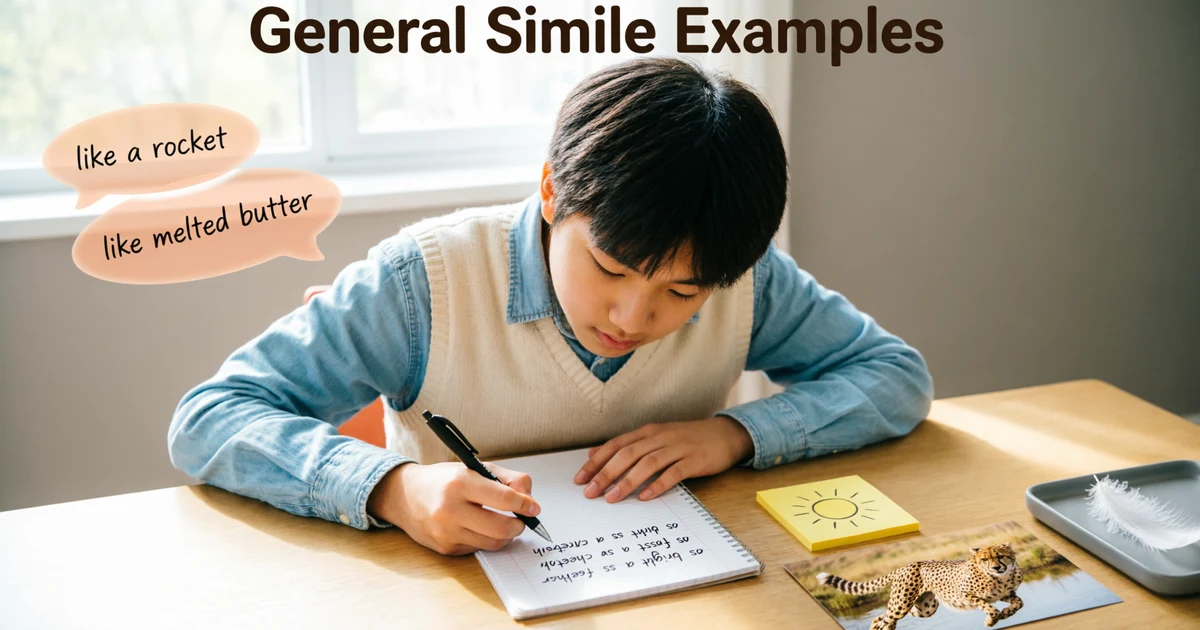
A good simile can make a plain sentence feel bright, clear, and easy to remember. Instead of saying someone runs fast, you can say someone runs like the wind. That small comparison gives the reader a stronger picture.
In this guide, you will learn what a general simile example means, how similes work, and how to use them in school work, essays, stories, daily speech, and creative writing. You will also see many simple examples with meanings, so you can understand the idea quickly and use it with confidence.
What Is a General Simile Example
A general simile example is a simple comparison that uses like or as to describe one thing by comparing it with another thing. Writers use similes to make ideas easier to picture.
A simile does not say that two things are exactly the same. It only says that they share one clear quality.
Examples:
- Her smile was as bright as the sun.
Meaning: Her smile looked very happy and cheerful.
- He ran like a cheetah.
Meaning: He ran very fast.
- The room was as quiet as a library.
Meaning: The room had very little noise.
A general simile works well because most readers understand the comparison quickly. Sun, cheetah, library, ice, feather, and rock all create clear images in the mind.
How General Similes Help Readers Understand Ideas
General similes help readers understand an idea through a familiar image. A reader may not know exactly how tired a person feels, but they can understand the feeling when the writer compares it to a heavy stone or an empty battery.
A plain sentence gives information.
Example:
She felt tired.
A simile gives a picture.
Example:
She felt as tired as a runner after a long race.
The second sentence gives more detail. It helps the reader imagine the level of tiredness. That is why teachers, students, poets, story writers, and speakers use similes often.
Similes help with:
- Clear description
- Stronger emotion
- Better imagination
- More interesting sentences
- Easier understanding
A good simile does not confuse the reader. It makes the meaning clearer.
Simple General Simile Examples With Meanings
Simple similes work best when the comparison feels familiar. These examples suit beginners, students, and anyone who wants clear writing.
- As cold as ice
Meaning: Very cold
Example: The water felt as cold as ice.
- As light as a feather
Meaning: Very light in weight
Example: The small scarf felt as light as a feather.
- As brave as a lion
Meaning: Very brave
Example: The firefighter stood as brave as a lion.
- As busy as a bee
Meaning: Very busy
Example: My mother stayed as busy as a bee all morning.
- As white as snow
Meaning: Very white
Example: The new sheets looked as white as snow.
- As slow as a turtle
Meaning: Very slow
Example: The old computer moved as slow as a turtle.
- As sharp as a knife
Meaning: Very sharp or very clever
Example: Her mind works as sharp as a knife.
These examples use common images, so readers can understand them without extra explanation.
Common General Simile Examples Used in Daily English
People use similes in daily speech without thinking too much about them. These comparisons make conversation more colorful and natural.
Examples:
- He eats like a horse.
Meaning: He eats a lot.
- She sings like an angel.
Meaning: She sings beautifully.
- My phone battery drains like water.
Meaning: The battery runs out very quickly.
- He sleeps like a baby.
Meaning: He sleeps deeply and peacefully.
- The news spread like fire.
Meaning: The news spread very fast.
- She works like a machine.
Meaning: She works with great energy and focus.
- His hands felt as cold as ice.
Meaning: His hands felt very cold.
Daily similes usually sound casual. They fit conversations, captions, short messages, and simple writing.
Easy General Simile Examples for Students
Students often need similes for grammar lessons, creative writing, paragraphs, and school assignments. The best student similes stay clear, simple, and meaningful.
Examples for students:
- The classroom was as noisy as a market.
- My backpack felt as heavy as a bag of bricks.
- The test was as difficult as a puzzle.
- The teacher explained the lesson like a guide.
- My friend laughed like a happy child.
- The bell rang like an alarm.
- The pencil moved across the page like a tiny dancer.
Students should choose similes that match the subject. A school paragraph needs simple comparisons. A story can use more creative comparisons.
Weak example:
The book was like something.
Better example:
The book was as heavy as a brick.
The better version tells the reader exactly what quality the writer wants to show.
General Simile Examples for Kids
Kids understand similes best when the examples use familiar things like animals, food, toys, weather, and school objects.
Examples for kids:
- The kitten was as soft as cotton.
- The puppy ran like a little rocket.
- The cake smelled as sweet as candy.
- The baby laughed like a tiny bell.
- The ball bounced like a frog.
- The moon looked as round as a cookie.
- The child jumped like a kangaroo.
These examples help children connect language with images. They also make writing more fun. A child can describe a toy, pet, friend, or place with a simple simile.
Practice idea:
Ask the child to complete these lines:
- The sun is as bright as
- My dog runs like
- The pillow feels as soft as
This helps kids create their own comparisons.
General Simile Examples for Creative Writing
Creative writing needs fresh images. A simile should help the reader feel the scene, not just understand it.
Plain sentence:
The street was dark.
Creative simile:
The street was as dark as a closed box.
Plain sentence:
She felt nervous.
Creative simile:
Her thoughts jumped like birds trapped in a room.
More examples:
- The rain tapped the window like nervous fingers.
- His anger rose like smoke from a fire.
- The old house groaned like a tired giant.
- Her voice floated through the room like soft music.
- The city lights glittered like stars on the ground.
- His hope grew like a small flame in the dark.
- The trees bent like dancers in the wind.
Creative similes work best when they match the mood. A funny story needs playful comparisons. A serious scene needs calm or emotional comparisons.
General Simile Examples for Essays
Essays need similes with care. Too many creative comparisons can make an academic paragraph sound informal. A good essay simile should explain an idea clearly without sounding childish.
Examples for essays:
- A strong argument works like a bridge between evidence and conclusion.
- Education acts like a key that opens future opportunities.
- Clear communication functions like a map during group work.
- A weak thesis is like a house without a foundation.
- Good evidence supports an essay like strong pillars support a building.
- A balanced routine works like fuel for steady progress.
- Reading widely grows the mind like sunlight grows a plant.
These similes suit essays because they explain abstract ideas. They do not sound silly or overdone.
Tip for essay writing:
Use similes only when they improve clarity. Do not add them just to decorate the paragraph.
General Simile Examples About People
Similes about people describe appearance, behavior, personality, mood, or action. They help readers picture a character or understand a person quickly.
Examples:
- She was as kind as a nurse.
- He stood as tall as a tree.
- Her face glowed like the morning sun.
- He moved like a shadow through the hallway.
- She stayed as calm as a quiet lake.
- His voice sounded like thunder.
- The child smiled like a ray of sunshine.
- He felt as proud as a king.
- She worked like a true artist.
- His eyes sparkled like stars.
When you write about people, choose a comparison that shows one clear trait. Do not compare too many qualities at once.
Weak example:
He was like a lion, a tree, and a storm.
Better example:
He stood as brave as a lion.
The better example keeps the image focused.
General Simile Examples About Animals
Animal similes work well because animals have strong known traits. Lions suggest bravery. Foxes suggest cleverness. Turtles suggest slowness. Bees suggest busyness.
Examples:
- As brave as a lion
- As sly as a fox
- As busy as a bee
- As slow as a turtle
- As gentle as a lamb
- As quiet as a mouse
- As free as a bird
- As strong as an ox
- As playful as a puppy
- As graceful as a swan
Sentence examples:
- She moved as graceful as a swan across the stage.
- He stayed as quiet as a mouse during the meeting.
- The little boy ran around the yard like a puppy.
- My grandfather remains as strong as an ox.
Animal similes suit stories, school writing, poems, and descriptions of personality.
General Simile Examples About Nature
Nature gives writers rich comparisons. You can compare feelings, movement, color, sound, and beauty with natural images.
Examples:
- Her smile was as warm as sunlight.
- The lake shone like glass.
- The flowers danced like happy children.
- His mood changed like the weather.
- The stars glittered like tiny diamonds.
- The wind whispered like a secret.
- The clouds floated like soft pillows.
- The mountain stood as still as a statue.
- The river moved like a silver ribbon.
- The sky looked as blue as the ocean.
Nature similes often make writing feel peaceful, emotional, or visual. They suit poems, descriptions, travel writing, and reflective essays.
General Simile Examples About Feelings
Feelings can feel hard to explain. Similes help writers show emotions in a way readers can understand.
Examples:
- She felt as happy as a child on a holiday.
- He felt as lonely as a boat in the ocean.
- My heart beat like a drum.
- Her fear spread like cold water through her body.
- He felt as angry as a storm.
- She felt as light as air after hearing the good news.
- His sadness sat in his chest like a heavy stone.
- My excitement grew like a fire.
- She felt as nervous as a student before an exam.
- He smiled like someone who had found treasure.
These similes help readers feel the emotion rather than only read the word. Strong writing often shows emotion through images and actions.
General Simile Examples About School
School similes help students write better paragraphs, essays, and stories about classroom life.
Examples:
- The classroom was as loud as a playground.
- The exam felt like a mountain to climb.
- My notebook looked as neat as a printed page.
- The teacher explained the topic like a patient coach.
- The library stayed as quiet as a sleeping house.
- The students rushed out like birds from a cage.
- My homework pile looked as tall as a tower.
- The school bus moved like a yellow caterpillar.
- The lesson was as clear as clean glass.
- My mind went blank like an empty board.
These examples work well for school essays and creative assignments. They use familiar images from student life.
General Simile Examples About Work
Work related similes describe effort, pressure, teamwork, focus, and progress. They can make business writing, speeches, and workplace stories more engaging.
Examples:
- She handled the project like a skilled captain.
- The deadline came at us like a fast train.
- He worked as steady as a clock.
- The team moved like a well trained crew.
- The office buzzed like a beehive.
- Her plan worked like a compass.
- The meeting dragged like a slow walk in the rain.
- His focus stayed as sharp as a needle.
- The new system ran like a smooth engine.
- The workload felt as heavy as a stone.
Work similes should sound professional. Avoid childish or silly comparisons in formal writing.
General Simile Examples Using Like
A simile with like compares an action, feeling, or quality to something familiar. Like often works well when you describe movement or behavior.
Examples:
- She danced like a leaf in the wind.
- He ran like a champion.
- The baby slept like an angel.
- The car moved like a rocket.
- His words cut like glass.
- The child laughed like a ringing bell.
- Her ideas flowed like water.
- The dog followed me like a shadow.
- The music filled the room like sunlight.
- He disappeared like smoke.
Use like when the sentence compares how something acts, moves, sounds, or feels.
Formula:
Subject plus action plus like plus comparison
Example:
The river moved like a ribbon through the valley.
General Simile Examples Using As
A simile with as often follows the pattern as adjective as noun. This structure helps writers describe a quality clearly.
Examples:
- As cold as ice
- As bright as the sun
- As soft as cotton
- As hard as stone
- As sweet as honey
- As quick as lightning
- As deep as the ocean
- As clear as glass
- As smooth as silk
- As fresh as morning air
Sentence examples:
- Her scarf felt as soft as silk.
- His answer was as clear as glass.
- The night felt as cold as ice.
- The child moved as quick as lightning.
Use as when you want a simple and direct description.
How to Write Your Own General Simile
You can write your own simile by choosing one quality and finding a familiar image that shares that quality.
Step by step method:
- Choose the thing you want to describe.
Example: A voice
- Choose the quality.
Example: Soft
- Choose something familiar with that quality.
Example: Silk
- Create the simile.
Example: Her voice was as soft as silk.
More examples:
- Thing: Rain
Quality: Gentle
Comparison: Fingers tapping
Simile: The rain tapped the roof like gentle fingers.
- Thing: Smile
Quality: Bright
Comparison: Sunlight
Simile: His smile shone like sunlight.
- Thing: Fear
Quality: Cold
Comparison: Ice
Simile: Fear moved through me like ice water.
A strong simile needs a clear link. The reader should understand why you chose that comparison.
Difference Between a Simile and a Metaphor
A simile compares two things using like or as.
Example:
Her voice was as sweet as honey.
A metaphor says one thing is another thing.
Example:
Her voice was honey.
Both create strong images, but they work in different ways. A simile makes the comparison clear. A metaphor makes the comparison more direct and powerful.
More examples:
Simile:
He fought like a lion.
Metaphor:
He was a lion in battle.
Simile:
The classroom was as noisy as a market.
Metaphor:
The classroom was a market.
Students often mix them up. The easiest way to remember the difference is simple. Similes use like or as. Metaphors do not need those words.
Common Mistakes to Avoid When Writing Similes
Similes can improve writing, but weak similes can make a sentence sound unclear or lazy. Avoid these common mistakes.
- Using unclear comparisons
Weak:
She was as nice as something good.
Better:
She was as kind as a nurse.
- Mixing too many images
Weak:
His mind was like a storm, a machine, and a river.
Better:
His mind raced like a storm.
- Choosing a comparison that does not match the meaning
Weak:
The baby was as loud as a feather.
Better:
The baby was as loud as a siren.
- Using too many similes in one paragraph
Too many comparisons can distract readers. Use similes where they add value.
- Using overused similes every time
Common similes work well for learning, but creative writing needs fresher images when possible.
Common:
As busy as a bee
Fresher:
She moved through the kitchen like a chef during the dinner rush.
Best General Simile Examples to Use in Sentences
Here are strong general simile examples that fit many types of writing.
- Her smile was as bright as morning light.
- He ran like the wind.
- The room felt as cold as ice.
- The child laughed like a tiny bell.
- His courage stood as firm as a mountain.
- The water shone like glass.
- Her hands felt as soft as cotton.
- The news spread like fire.
- His voice sounded as deep as thunder.
- The dog followed her like a shadow.
- My heart beat like a drum.
- The baby slept as peacefully as a kitten.
- The idea grew like a seed in my mind.
- His anger rose like smoke.
- The stars glittered like diamonds.
- The old chair creaked like a tired door.
- She stayed as calm as a quiet lake.
- The answer came as clear as daylight.
- The city moved like a living machine.
- His words felt as sharp as a knife.
These examples show different uses. Some describe people. Some describe feelings. Some describe places, actions, and ideas.
Conclusion
General simile examples help writers turn simple sentences into clear and memorable descriptions. A simile uses like or as to compare one thing with another, so the reader can picture the meaning quickly.
The best similes stay clear, natural, and useful. They do not confuse the reader or decorate the sentence without purpose. Whether you write for school, essays, stories, captions, or daily conversation, a strong simile can make your writing more expressive and easier to understand.
Start with simple comparisons, then create your own. Choose one quality, find a familiar image, and build a sentence that helps the reader see or feel your idea.
FAQs
What is a general simile example
A general simile example is a simple comparison that uses like or as. Example: Her smile was as bright as the sun.
What are 5 examples of similes
Five examples include as cold as ice, as brave as a lion, runs like the wind, as soft as cotton, and shines like a star.
How do you write a simple simile
Choose something to describe, pick one quality, then compare it with something familiar using like or as.
What is a simile example for students
A useful student example is: The classroom was as noisy as a playground.
What is a simile using like
A simile using like compares one thing with another through the word like. Example: He ran like a cheetah.
What is a simile using as
A simile using as often follows the pattern as adjective as noun. Example: The pillow felt as soft as cotton.
Why do writers use similes
Writers use similes to make descriptions clearer, stronger, and easier to imagine.
What makes a good simile
A good simile has a clear comparison, a strong image, and a meaning that readers can understand quickly.
Can I use similes in essays
Yes, you can use similes in essays when they explain an idea clearly. Use them carefully and keep the tone suitable for the topic.
What is the difference between a simile and a metaphor
A simile uses like or as to compare two things. A metaphor makes a direct comparison without using like or as.