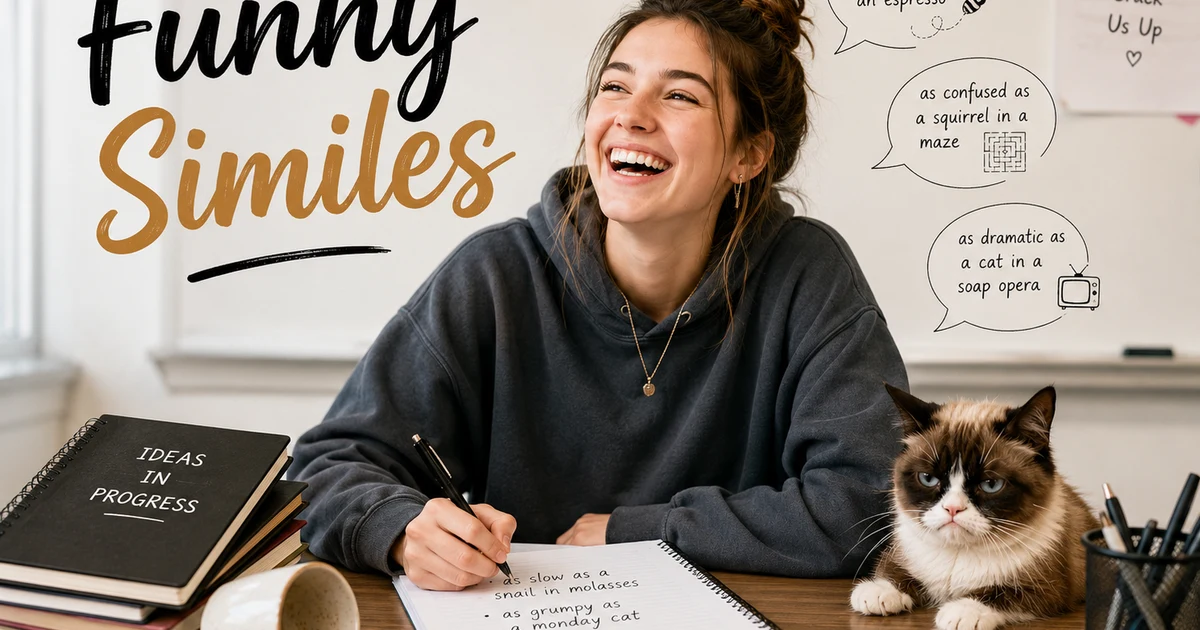
Funny similes can turn a plain sentence into something people remember. Instead of saying someone ran fast, you can say they ran like a squirrel late for a nut sale. That small comparison adds humor, image, and personality.
In this guide, you will learn what a funny simile is, how it works, and how to use it in writing, school tasks, captions, stories, and everyday speech. You will also see many funny simile examples with simple meanings so you can use them with confidence.
What Is a Funny Simile
A funny simile compares one thing to another in a humorous way using like or as. It helps readers picture an idea while also making them smile.
A normal simile might say:
She was as quiet as a mouse.
A funny simile might say:
She was as quiet as a mouse wearing slippers in a library.
Both sentences show quietness, but the funny version adds a playful image. That extra detail makes the sentence more memorable.
Funny similes work best when the comparison feels surprising but still makes sense. A good funny simile should help the reader understand the meaning, not confuse them.
Examples:
- He danced like a giraffe on roller skates.
- My backpack felt as heavy as a sleeping elephant.
- She smiled like someone who found extra fries at the bottom of the bag.
- The classroom was as noisy as a zoo at lunchtime.
Why Funny Similes Make Writing More Memorable
Funny similes make writing stand out because they create a clear mental picture. Readers remember images better than plain descriptions.
For example, this sentence feels simple:
The dog looked confused.
This version feels stronger:
The dog looked as confused as a tourist reading a map upside down.
The second sentence gives the reader a funny picture. It also tells us exactly what kind of confusion the dog had.
Funny similes also add voice. They show personality, humor, and creativity. A student can use them to make a school story more interesting. A writer can use them to make a character sound lively. A speaker can use them to make people laugh.
A strong funny simile usually does three things:
- It explains the idea clearly.
- It creates a funny image.
- It matches the tone of the sentence.
Funny Similes With Simple Meanings
Funny similes become easier to use when you understand their meanings. Here are some practical examples.
- As hungry as a bear at a buffet
Meaning: Extremely hungry - Like a chicken trying to do ballet
Meaning: Awkward movement - As slow as a snail with a heavy backpack
Meaning: Very slow - Like a phone at one percent battery
Meaning: Very tired or weak - As excited as a dog hearing the word walk
Meaning: Very excited - Like a penguin in a dance contest
Meaning: Funny or clumsy - As confused as a cat in a bathtub
Meaning: Very confused - Like a kid spotting cake
Meaning: Very happy or eager - As dramatic as a soap opera villain
Meaning: Overly emotional - Like socks in a dryer
Meaning: Lost, mixed up, or hard to find
These examples work because they connect common feelings with playful images.
Funny Similes for Students
Students often use similes in stories, poems, essays, and classroom activities. Funny similes can help school writing feel more alive, especially when the teacher asks for creative language.
Examples for students:
- My brain felt like a browser with too many tabs open.
- The test stared at me like it knew all my secrets.
- I walked into class as nervous as a cat near a vacuum cleaner.
- My pencil moved as slowly as traffic on a rainy morning.
- The lunch line stretched like a snake with no plans.
Students should use funny similes where they fit naturally. A creative story can handle more humor. A serious essay needs fewer funny comparisons.
Good classroom use:
The hallway buzzed like a beehive before the final bell.
Weak classroom use:
The history essay was like a pizza with extra cheese.
The second example sounds funny, but it does not clearly explain the idea. Funny similes still need meaning.
Funny Similes for Kids
Kids enjoy similes when the images feel simple, silly, and easy to picture. Animal, food, school, and family examples work well.
Examples for kids:
- He jumped like a frog in new sneakers.
- She laughed like a hyena at a comedy show.
- The baby crawled like a tiny turtle in a hurry.
- My hair looked like spaghetti after the wind.
- The puppy ran like a fluffy rocket.
Funny similes for kids should stay clear and age friendly. Avoid complex comparisons that need adult knowledge. A child understands dogs, pizza, toys, school bags, cartoons, and animals better than abstract ideas.
Good kid friendly simile:
The cake disappeared like magic at a birthday party.
This sentence works because every child can picture it.
Funny Similes for Creative Writing
Creative writing gives you more freedom. You can use funny similes to build character, mood, and scene.
A nervous character might think:
My hands shook like jelly on a bumpy bus.
A messy room might look like this:
His bedroom looked like a laundry basket had exploded during a pillow fight.
A clumsy villain might move like this:
He crept across the room like a refrigerator trying to be sneaky.
Creative writing needs fresh comparisons. Try to avoid overused similes such as as busy as a bee or as cold as ice unless you add a twist.
Plain version:
She was as busy as a bee.
Better funny version:
She was as busy as a bee running three coffee shops.
The second version feels more original and fun.
Funny Similes for Essays and School Assignments
You can use funny similes in school assignments, but you need to match the subject. A personal narrative, speech, poem, or creative essay can include humor. A formal research essay needs more control.
Good for personal writing:
During the spelling test, my mind went blank like a whiteboard after cleaning day.
Good for descriptive writing:
The old chair creaked like it had a complaint about every person who sat on it.
Good for narrative writing:
My little brother followed me around like a duckling with questions.
Use funny similes in essays when they add clarity. Do not force jokes into serious topics. A strong writer knows when humor helps and when it distracts.
Funny Similes About People
Funny similes about people can describe appearance, behavior, mood, or movement. Keep them kind and avoid cruel comparisons.
Examples:
- He walked like a penguin late for school.
- She talked as fast as an auctioneer with too much coffee.
- My uncle snores like a lawn mower with a cold.
- The toddler ran like a tiny boss with urgent business.
- He looked as proud as a cat sitting on clean laundry.
Funny people similes work best when they describe a situation, not attack someone. Humor should feel playful, not mean.
Kind humor:
He looked as serious as a squirrel guarding one peanut.
Harsh humor can make writing feel rude. Choose comparisons that entertain without insulting.
Funny Similes About Animals
Animal similes feel natural because animals already have strong personalities in our minds. Cats seem dramatic, dogs seem excited, turtles seem slow, and monkeys seem playful.
Examples:
- She stretched like a cat who owned the whole couch.
- He ate like a raccoon at an open trash can.
- The kids ran around like puppies after bath time.
- My brother stared like an owl who heard gossip.
- The teacher waited as patiently as a turtle at a red light.
Animal similes work in stories, captions, speeches, and classroom writing. They make scenes easy to imagine.
A strong animal simile should match the action. Use a cheetah for speed, a sloth for slowness, a cat for attitude, and a dog for excitement.
Funny Similes About Food
Food similes add humor because everyone understands hunger, snacks, sweets, and messy meals. They also make writing more sensory.
Examples:
- He melted into the sofa like butter on hot toast.
- She looked as happy as a kid with a giant cupcake.
- My ideas scattered like popcorn in a microwave.
- The baby was as sticky as syrup on a breakfast plate.
- His plan fell apart like a soggy sandwich.
Food similes work well in informal writing. They can describe emotions, mistakes, mess, comfort, and excitement.
Example in a sentence:
After practice, I felt as flat as a pancake under a backpack.
This gives readers both humor and meaning.
Funny Similes About School
School gives writers many chances to use funny similes. Tests, homework, lockers, lunch lines, teachers, and sleepy mornings all create relatable humor.
Examples:
- Monday morning hit me like an alarm clock with anger issues.
- My locker smelled like old sneakers holding a meeting.
- The math problem looked as friendly as a locked door.
- The class went silent like someone had paused the whole room.
- Homework followed me like a shadow with a clipboard.
Funny school similes work well for students because they feel familiar. They also make classroom writing less dull.
A good school simile should connect with a real student experience. That makes the humor land.
Funny Similes About Work
Work similes can describe stress, meetings, deadlines, tiredness, or office humor. They fit emails, speeches, stories, and social captions when the tone allows it.
Examples:
- The meeting dragged on like a slow elevator.
- My inbox grew like weeds after rain.
- He typed like a squirrel chasing a deadline.
- The office felt as quiet as a library at midnight.
- Friday afternoon moved like honey from a cold jar.
Funny work similes should stay professional if you use them in public writing. A light joke can make a point. Too much sarcasm can sound careless.
Better workplace example:
The deadline moved closer like a cat sneaking toward an open sandwich.
This feels funny but still clear.
Funny Similes About Being Tired
Tiredness gives writers many chances for humor because everyone knows the feeling. Funny similes can show exhaustion without using the same old phrases.
Examples:
- I felt like a phone with one percent battery.
- She looked as tired as a parent at a school concert.
- My legs moved like noodles after gym class.
- He blinked like a sleepy owl in bright sunlight.
- I was as drained as a bathtub after a long bath.
These similes work because they connect tiredness with common images. Phones, noodles, sleepy animals, and drained tubs all make the meaning easy to understand.
Sentence example:
After the exam, my brain felt like soup in a blender.
This shows mental tiredness in a funny way.
Funny Similes About Being Angry
Anger can sound too serious if you describe it plainly. Funny similes can soften the mood while still showing strong emotion.
Examples:
- He looked as angry as a cat in a rainstorm.
- She stomped like a dinosaur with a parking ticket.
- My dad frowned like the remote had betrayed him.
- The coach shouted like a kettle ready to burst.
- His face turned red like a tomato with opinions.
Use funny anger similes carefully. They fit comic writing, light stories, and playful descriptions. They may not suit serious conflict.
A useful sentence:
My little sister glared at me like I had eaten the last cookie, which I had.
This adds humor and story at the same time.
Funny Similes About Being Happy
Happy similes should feel bright, warm, and energetic. Humor can make joy feel even more expressive.
Examples:
- She smiled like she found money in an old jacket.
- He jumped like popcorn in a hot pan.
- The dog wagged its tail like a tiny fan on full speed.
- I felt as happy as a kid on the first day of holidays.
- My grandma laughed like music had spilled out of her.
Funny happy similes work well in personal stories, cards, captions, and speeches. They help readers feel the joy instead of only reading about it.
Good sentence:
When I saw the pizza arrive, I smiled like a student hearing the word free.
Simple, clear, and funny.
Funny Similes for Everyday Conversation
Funny similes can make normal conversation more lively. You can use them when talking with friends, writing messages, or telling a story.
Examples:
- I slept like a rock with a blanket.
- This bag feels as heavy as a small car.
- You vanished like snacks at a party.
- I am moving like a turtle on a lazy Sunday.
- That joke landed like a pancake on the floor.
Everyday similes should sound natural. If they feel too long, shorten them.
Too long:
I am as tired as a person who walked across a desert while carrying many boxes and thinking about emails.
Better:
I am as tired as a phone begging for a charger.
Shorter often sounds funnier.
Funny Similes You Can Use in Captions
Captions need quick humor. A funny simile can make a photo, reel, or post more engaging.
Caption examples:
- Smiling like I found fries in the bag.
- Tired like a phone at one percent.
- Moving like a sloth with weekend plans.
- Happy like a dog near an open park.
- Busy like a bee with a calendar.
- Calm like a cat on a sunny windowsill.
- Hungry like a bear at breakfast.
- Confused like a GPS in a tunnel.
- Fresh like laundry on a sunny day.
- Dramatic like a toddler denied candy.
For captions, keep the simile short and easy to understand. Long comparisons can feel awkward on social media.
How to Write Your Own Funny Simile
You can write a funny simile by starting with the feeling or action you want to describe.
Step 1: Choose the idea
Example: tired
Step 2: Think of a familiar object or scene
Example: phone battery, sleepy cat, flat balloon
Step 3: Add a funny detail
Example: a phone at one percent during a long trip
Step 4: Make the sentence clear
Example: I felt like a phone at one percent during a long trip.
Here is a simple formula:
Subject plus action or feeling plus like or as plus funny comparison.
Examples:
- My brain felt like a browser with too many tabs open.
- He ran like a sandwich thief in a food court.
- She laughed like a kettle with good news.
- The room smelled like socks had formed a club.
The best funny similes come from everyday life. Look at school, food, pets, family, weather, sports, and technology for ideas.
Common Mistakes When Using Funny Similes
Funny similes can improve writing, but weak ones can confuse readers. Avoid these common mistakes.
- Making the comparison too random
Weak:
He was as brave as a sandwich.
Better:
He was as brave as a kitten facing a vacuum cleaner.
The better version creates a clear image.
- Making it too long
Weak:
She was as excited as someone who had waited for many weeks and then finally found out that the thing she wanted had arrived.
Better:
She was as excited as a dog hearing the word walk.
- Using too many funny similes in one paragraph
Too much humor can tire the reader. Use similes where they add value.
- Using rude comparisons
Funny does not need to hurt someone. Keep the tone playful.
- Choosing a simile that does not match the mood
A silly simile may not fit a serious scene. Match the comparison to the purpose.
Best Funny Similes for Writers and ESL Learners
Writers and ESL learners can use funny similes to build vocabulary, improve descriptions, and understand figurative language. The key is to learn both meaning and context.
Best examples to remember:
- As busy as a bee with a packed calendar
Meaning: Very busy - Like a cat pretending nothing happened
Meaning: Acting innocent after causing trouble - As tired as a phone looking for a charger
Meaning: Very tired - Like popcorn in a hot pan
Meaning: Full of energy - As confused as a GPS in a tunnel
Meaning: Very confused - Like a duck in tiny shoes
Meaning: Awkward or clumsy - As happy as a dog at the park
Meaning: Very happy - Like a squirrel with too many ideas
Meaning: Restless or distracted - As slow as cold syrup
Meaning: Very slow - Like a chair with a secret squeak
Meaning: Awkwardly noisy or uncomfortable
ESL learners should first use simple similes. After they understand the structure, they can create more creative ones. Writers should focus on originality and timing.
Conclusion
Funny similes make writing clearer, warmer, and more memorable. They help readers picture emotions, actions, and scenes in a fresh way. A good funny simile does more than make people laugh. It explains the idea with a creative image.
Use funny similes when they fit your purpose. Keep them clear, kind, and easy to picture. Whether you write a school story, caption, speech, essay, or creative scene, the right simile can make your words feel more alive.
FAQs
What is a funny simile
A funny simile compares two things in a humorous way using like or as. It helps explain an idea while creating a playful image.
What is an example of a funny simile
An example is: My brain felt like a browser with too many tabs open. It means someone feels confused or mentally overloaded.
Can students use funny similes in essays
Yes, students can use funny similes in creative essays, personal narratives, and descriptive writing. Formal essays need a more careful tone.
What makes a simile funny
A simile becomes funny when it uses a surprising comparison that still makes sense. The humor should support the meaning.
Are funny similes good for kids
Yes, funny similes help kids understand comparison, humor, and description. Simple examples with animals, food, and school work best.
How do I write a funny simile
Choose a feeling or action, then compare it to a familiar funny image. Keep the sentence short and clear.
What is a funny simile for tired
A good funny simile for tired is: I felt like a phone at one percent battery. It clearly shows low energy.
What is a funny simile for happy
A funny simile for happy is: She smiled like she found extra fries in the bag. It shows simple, relatable joy.
What is a funny simile for slow
A funny simile for slow is: He moved like a snail carrying luggage. It creates a clear and silly picture.
Can funny similes improve creative writing
Yes, funny similes can improve creative writing by adding voice, humor, and vivid imagery. They make scenes easier to remember.