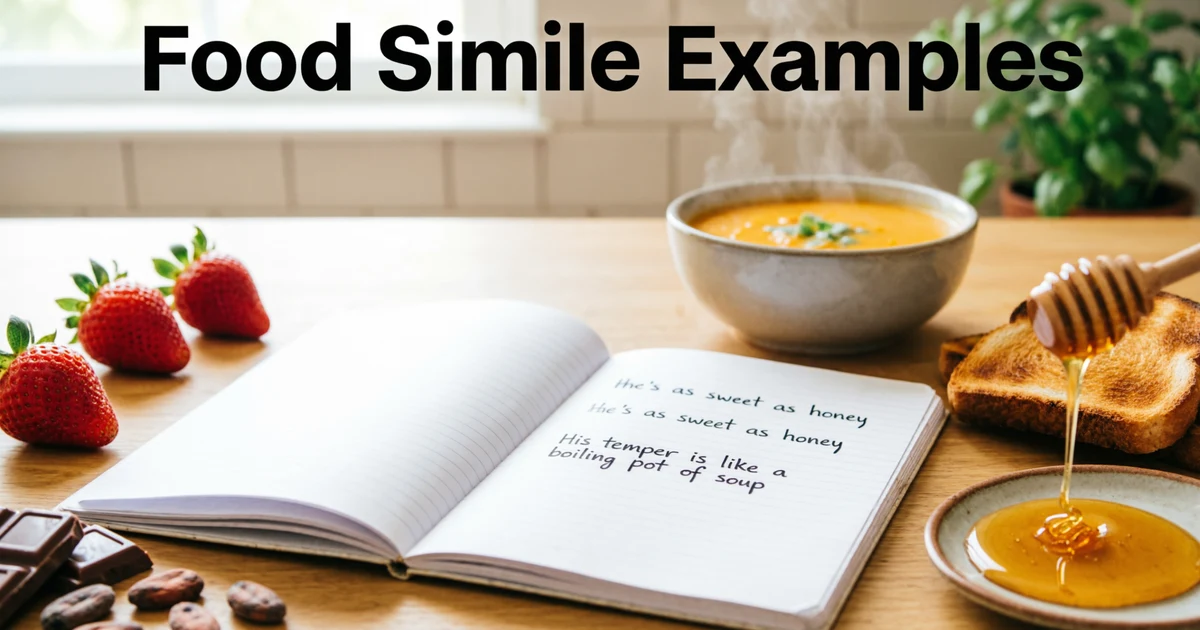
Food can make writing feel warmer, clearer, and more alive. A simple food simile can help readers understand taste, smell, texture, mood, beauty, anger, comfort, love, or personality in a way they can feel right away.
In this guide, you will learn what a food simile means, how writers use it, and how to write your own. You will also find many food simile examples with meanings and sentences for students, kids, stories, poems, captions, and everyday writing.
What Is a Food Simile
A food simile compares something to food using words such as like or as. Writers use it to make an idea easier to picture.
Examples:
Her smile was as sweet as honey.
The soup felt as warm as a hug.
His words tasted as bitter as burnt coffee.
In each example, food helps explain a feeling or quality. Honey suggests sweetness. Soup suggests comfort. Burnt coffee suggests bitterness or unpleasant emotion.
A food simile works well because everyone knows food through taste, smell, sight, and touch. That makes the comparison easy to understand.
Food Simile Meaning in Simple Words
A food simile means a comparison between something and food. It does not say the thing actually becomes food. It only says it shares a quality with food.
For example:
The baby was as soft as pudding.
This does not mean the baby looks like pudding. It means the baby feels soft and gentle.
Another example:
Her voice was like warm tea on a cold night.
This means her voice sounds comforting and calm.
Food similes help describe:
Sweetness
Warmth
Bitterness
Comfort
Softness
Richness
Freshness
Hunger
Joy
Disgust
They turn plain writing into writing that readers can sense.
Why Writers Use Food Similes
Writers use food similes because food connects with memory and emotion. A reader may not know your exact feeling, but they probably understand the taste of sugar, the smell of fresh bread, or the burn of chili.
Food similes help writers:
Make descriptions more vivid
Create a clear mood
Add humor or warmth
Explain emotions in simple words
Make scenes feel real
For example:
Plain sentence: She felt happy.
Better sentence: She felt as light and sweet as whipped cream.
The second sentence gives the reader a stronger image. It also adds a soft and cheerful tone.
Writers also use food similes in stories, poems, speeches, captions, and classroom writing because they feel natural and easy to remember.
Common Food Similes for Everyday Writing
Some food similes appear often because they sound familiar and clear. These examples work well in daily writing.
Examples:
As sweet as sugar
As smooth as butter
As cool as ice cream
As warm as soup
As fresh as a salad
As soft as bread
As bitter as dark chocolate
As sticky as syrup
As light as whipped cream
As rich as cream
Example sentences:
Her kindness was as sweet as sugar.
The road felt as smooth as butter after the rain cleared.
His reply was as bitter as dark chocolate.
The blanket felt as warm as soup on a cold evening.
These similes help readers understand meaning quickly. They work best when you choose food that matches the exact feeling or image.
Food Similes With Clear Meanings
A strong food simile should create a clear meaning. The food you choose must match the idea you want to express.
Here are useful examples:
As sweet as honey means very kind, pleasant, or loving.
As sour as a lemon means sharp, unpleasant, or bad tempered.
As soft as cake means gentle, tender, or easy to touch.
As hot as chili means very spicy, angry, or intense.
As fresh as mint means clean, lively, or new.
As bland as plain rice means dull or lacking excitement.
As rich as chocolate means deep, strong, or luxurious.
Example sentences:
Her laugh sounded as sweet as honey.
He made a face as sour as a lemon.
The new towel felt as soft as cake.
The argument grew as hot as chili.
The morning air felt as fresh as mint.
When your meaning stays clear, your simile helps the reader instead of confusing them.
Food Similes With Example Sentences
Food similes become easier to understand when you see them in full sentences.
Examples:
Her voice was as smooth as melted chocolate.
The classroom smelled like fresh bread after lunch.
His mood turned as sour as spoiled milk.
The baby’s cheeks looked as round as apples.
The joke landed as flat as stale bread.
The rain tapped the roof like popcorn popping in a pan.
The old chair creaked like dry toast breaking.
Her happiness spread like butter on warm bread.
His anger burned like hot pepper on the tongue.
The evening felt as calm as warm milk.
These sentences show how food similes can describe sound, smell, emotion, shape, movement, and atmosphere.
Food Similes for Taste and Flavor
Taste gives writers a strong way to describe feelings and experiences. Food similes about taste often show sweetness, bitterness, sourness, richness, or blandness.
Examples:
Her compliment was as sweet as caramel.
His apology tasted as bitter as black coffee.
The memory felt as sour as vinegar.
The victory felt as rich as chocolate cake.
The story felt as bland as plain oatmeal.
Example sentences:
The first bite of success felt as sweet as caramel.
His harsh words stayed in my mind like bitter coffee.
Their friendship turned as sour as vinegar after the argument.
The celebration felt as rich as chocolate cake.
Use taste similes when you want the reader to feel emotion almost physically.
Food Similes for Smell and Aroma
Smell can create memory faster than almost any other sense. Food similes about smell help build setting and mood.
Examples:
The kitchen smelled like fresh bread at sunrise.
Her perfume was as warm as cinnamon.
The garden smelled as sweet as ripe peaches.
The market smelled like roasted nuts and spices.
The room smelled as stale as old crackers.
Example sentences:
Grandma’s house smelled like fresh bread and warm butter.
The winter air carried a scent as warm as cinnamon.
The old cupboard smelled as stale as forgotten crackers.
The festival street smelled like roasted corn and sweet syrup.
Smell similes work well in stories because they make a scene feel lived in.
Food Similes for Texture and Touch
Food can describe how something feels. Texture similes help readers imagine softness, roughness, stickiness, smoothness, or crispness.
Examples:
The pillow felt as soft as marshmallows.
The floor felt as sticky as syrup.
Her skin felt as smooth as cream.
The dry leaves cracked like chips.
The blanket felt as fluffy as whipped cream.
Example sentences:
The kitten’s fur felt as soft as marshmallows.
The spilled juice made the table as sticky as syrup.
His hands felt rough, like dry biscuits.
The new scarf felt as smooth as cream.
Texture similes suit descriptive writing, especially when you describe objects, clothes, weather, animals, or people.
Food Similes for Feelings and Emotions
Food similes can explain feelings in a simple and memorable way. They help readers understand emotions without long explanations.
Examples:
Her joy bubbled like soda.
His sadness sat heavy as uncooked dough.
My fear grew cold like ice cream.
Her guilt stuck to her like syrup.
His excitement popped like popcorn.
Example sentences:
Her joy bubbled like soda during the party.
My worry sat in my stomach like uncooked dough.
His fear spread through him like melting ice cream.
Her guilt stuck to her like syrup on fingers.
These similes work because emotions often feel physical. Food gives those feelings a shape.
Food Similes for People and Personality
Food similes can describe personality in a playful or meaningful way. They can show kindness, sharpness, warmth, dullness, confidence, or charm.
Examples:
She was as sweet as honey.
He was as sharp as ginger.
My uncle was as warm as fresh bread.
The new student felt as shy as a pea in a pod.
Her humor was as dry as toast.
Example sentences:
My teacher was as patient and warm as fresh bread.
His personality was as sharp as ginger, but never cruel.
She entered the room as bright as a bowl of fresh fruit.
His jokes felt as dry as toast.
Use these similes carefully. A food comparison can sound funny, kind, or rude depending on your wording.
Food Similes for Love and Sweetness
Food similes often describe love because sweet foods naturally suggest care, affection, and tenderness.
Examples:
Your love is as sweet as honey.
Her smile was like sugar in tea.
His hug felt as warm as fresh bread.
Their love grew like dough in a warm kitchen.
Her words were as gentle as milk.
Example sentences:
Your kindness is as sweet as honey on a cold morning.
Her smile melted my anger like sugar in hot tea.
His hug felt as warm as fresh bread from the oven.
Their love grew slowly, like dough rising in a quiet kitchen.
These similes suit poems, love notes, romantic captions, and emotional scenes.
Food Similes for Anger and Bitterness
Food can also describe anger, resentment, jealousy, and harsh feelings. Bitter, sour, spicy, and burnt foods work well for these emotions.
Examples:
His anger burned like chili.
Her words were as bitter as black coffee.
The argument turned as sour as spoiled milk.
His jealousy tasted like vinegar.
Her stare felt as sharp as raw onion.
Example sentences:
His anger burned like chili on the tongue.
Her reply came out as bitter as black coffee.
The family dinner turned as sour as spoiled milk.
His jealousy sat in the room like vinegar in the air.
These similes help show conflict without over explaining it.
Food Similes for Happiness and Comfort
Comfort often links with warm, familiar foods. These similes help create a cozy and safe feeling.
Examples:
Her laugh felt like warm soup.
The blanket felt as comforting as hot chocolate.
Home felt like fresh bread after a long day.
His voice was as soft as warm milk.
The memory felt as sweet as pudding.
Example sentences:
Her laugh filled the room like warm soup on a rainy evening.
The old blanket felt as comforting as hot chocolate.
After months away, home felt like fresh bread.
His calm voice was as soft as warm milk.
These similes work well in personal writing, stories, reflective essays, and descriptions of home.
Funny Food Similes That Sound Natural
Funny food similes add personality to writing. They work best when they sound surprising but still clear.
Examples:
He ran like a potato rolling downhill.
She looked as confused as a noodle in a toolbox.
The dog jumped like popcorn in a hot pan.
His dance moves were as wobbly as jelly.
My plan collapsed like a soggy sandwich.
Example sentences:
He ran across the yard like a potato rolling downhill.
She stared at the math problem as confused as a noodle in a toolbox.
The puppy bounced around like popcorn in a hot pan.
His confidence shook like jelly on a plate.
Funny similes work well in children’s writing, informal stories, captions, and comic scenes.
Food Similes for Students
Students can use food similes to make school writing more creative. They work well in essays, descriptive paragraphs, short stories, poems, and speech writing.
Useful examples:
The sun was as golden as butter.
The moon looked like a round cookie.
The classroom buzzed like soda fizzing in a glass.
My nervousness sat in my stomach like heavy bread.
Her idea was as fresh as mint.
Example sentences:
The moon looked like a cookie floating in the dark sky.
The class buzzed with noise like soda fizzing in a glass.
My nervousness sat in my stomach like heavy bread before the speech.
Food similes help students write with sensory detail. They also make simple sentences stronger.
Food Similes for Kids
Kids understand food easily, so food similes help them learn comparisons faster. Simple examples work best.
Examples:
As sweet as candy
As soft as cake
As round as a cookie
As sticky as jam
As cold as ice cream
As warm as soup
As yellow as butter
As red as an apple
Example sentences:
The kitten was as soft as cake.
The ball was as round as a cookie.
My hands felt as sticky as jam.
The snow felt as cold as ice cream.
These examples help children learn how similes compare one thing to another using familiar foods.
Creative Food Similes for Stories and Poems
Creative food similes make stories and poems feel original. Choose food that matches your scene, character, and mood.
Examples:
The sunset melted like orange marmalade across the sky.
Her secret sat between them like a seed stuck in the teeth.
The city lights scattered like sugar on a dark cake.
His silence grew thick as cold honey.
The stars looked like salt sprinkled on black cloth.
Example sentences:
The sunset melted like orange marmalade across the sky.
His silence grew thick as cold honey.
The city lights scattered like sugar across the night.
Her secret stayed with her like a seed stuck in the teeth.
Creative similes need precision. A fresh comparison can make your writing memorable.
How to Use a Food Simile in a Sentence
A food simile needs three parts:
The thing you describe
The comparison word like or as
The food image that explains the quality
Formula examples:
Subject plus as plus adjective plus as plus food
Subject plus verb plus like plus food image
Examples:
Her voice was as smooth as cream.
The clouds floated like whipped cream.
His anger burned like pepper.
The baby’s cheeks looked as round as apples.
To write your own food simile, ask:
What quality do I want to describe?
Which food has that quality?
Does the comparison sound clear?
Does it fit the tone?
Good food similes feel natural. Forced similes distract the reader.
Common Mistakes to Avoid When Writing Food Similes
Food similes can improve writing, but weak choices can make writing confusing or silly.
Avoid these mistakes:
Using a food that does not match the meaning
Writing too many similes in one paragraph
Choosing a comparison that sounds unclear
Mixing too many senses at once
Using common similes without adding fresh context
Weak example:
Her sadness was as spicy as cake.
This does not work because cake does not suggest spice or sadness.
Better example:
Her sadness sat heavy as uncooked dough.
This works because the image feels heavy and uncomfortable.
Another weak example:
His smile was as sweet as sugar, honey, candy, cake, and syrup.
This feels crowded.
Better example:
His smile was as sweet as honey.
A clear simile always beats a crowded one.
Conclusion
A food simile uses familiar tastes, smells, textures, and memories to make writing clearer and more vivid. It can describe love, anger, comfort, fear, beauty, humor, personality, and setting with simple comparisons.
The best food similes match the exact feeling you want to show. Sweet foods can suggest kindness or love. Bitter foods can show hurt or anger. Warm foods can create comfort. Fresh foods can show energy and newness.
When you write a food simile, choose one clear food image and make sure the reader can feel the comparison. A simple line like her voice was as warm as soup can say more than a long explanation.
FAQs
What is a food simile?
A food simile compares something to food using like or as. Example: Her smile was as sweet as honey.
What is an example of a food simile?
One example is: The baby’s cheeks were as round as apples. It compares the shape of the cheeks to apples.
Why do writers use food similes?
Writers use food similes because food creates strong sensory images. It helps readers understand taste, smell, mood, texture, and emotion.
What are good food similes for kids?
Good food similes for kids include as sweet as candy, as round as a cookie, as sticky as jam, and as cold as ice cream.
What food simile describes happiness?
A good food simile for happiness is: Her joy bubbled like soda. It shows excitement and energy.
What food simile describes anger?
A strong food simile for anger is: His anger burned like chili. It shows heat, sharpness, and intensity.
What food simile describes love?
A sweet food simile for love is: Her love was as warm as fresh bread. It suggests comfort, care, and closeness.
Can food similes sound funny?
Yes. Example: He danced like jelly on a plate. Funny food similes work well in light stories and casual writing.
How do students use food similes in writing?
Students can use food similes to describe people, weather, feelings, places, and objects. Example: The moon looked like a cookie in the sky.
What makes a food simile strong?
A strong food simile matches the exact idea clearly. It uses a familiar food image and helps the reader see, feel, or understand the description.