Quick Answer
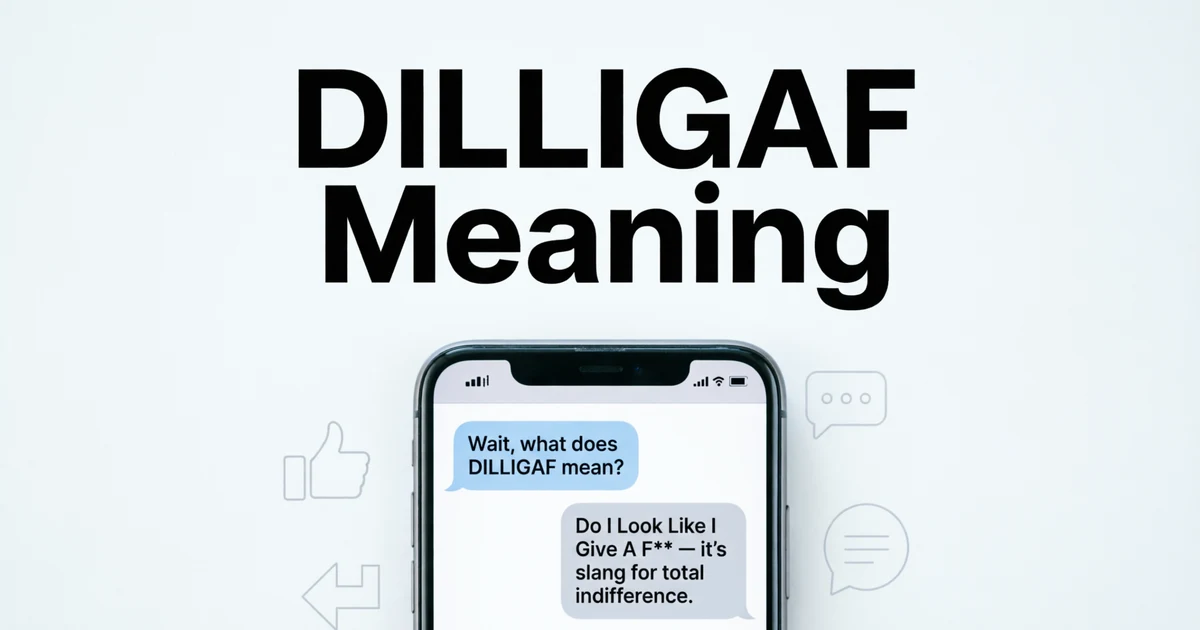
DILLIGAF stands for Do I Look Like I Give A F*?** It is a blunt slang acronym used to say that someone does not care about a situation, criticism, opinion, or outcome. The expression usually carries a sarcastic, annoyed, rebellious, or dismissive tone.
Because the final word is profanity, DILLIGAF is best suited to casual conversations, memes, private texts, and situations where strong language is acceptable. It can sound funny among friends, but rude or confrontational in professional or unfamiliar settings.
Introduction
You may see DILLIGAF in a text message, social media comment, meme, shirt, sticker, or online username and wonder what all seven letters mean. Unlike many internet abbreviations that simply save typing time, DILLIGAF communicates an attitude as much as a sentence.
The acronym essentially means that the speaker does not care. Depending on the conversation, it can express genuine indifference, frustration, sarcasm, defiance, or playful confidence. Someone might use it after being criticized for a harmless personal choice, while another person might use it jokingly with friends.
DILLIGAF also predates many of the slang abbreviations that became popular through modern social media. It has been associated with Australian comedy culture and was notably used by Australian comedian and musician Kevin Bloody Wilson.
Knowing the literal definition is only part of understanding the term. Tone matters. This guide explains the DILLIGAF meaning, how people use it in texts and social media, what it communicates emotionally, when it may be inappropriate, and which similar expressions you can use instead.
What Does DILLIGAF Mean?
DILLIGAF is an acronym for Do I Look Like I Give A F*?** In simpler language, it means something close to Do I look like I care?
It usually tells another person that the speaker has little or no concern about the subject being discussed.
For example, imagine someone criticizing your choice of sneakers.
Friend: Everyone says those shoes look weird.
You: DILLIGAF?
Here, the response means that you do not care whether other people approve of your shoes.
The expression is stronger than simply saying I do not care. The question format adds attitude. It suggests that the speaker believes their lack of concern should already be obvious.
Depending on tone and context, DILLIGAF can communicate several feelings:
- Indifference
- Annoyance
- Sarcasm
- Defiance
- Confidence
- Frustration
- Playful rebelliousness
This is why understanding the conversation around the acronym matters. Between close friends, it may be humorous. During an argument, the exact same word can feel aggressive.
What Does DILLIGAF Mean in Text?
In texting, DILLIGAF usually means that the sender does not care about something another person mentioned.
Someone might type it as a complete response:
Person 1: People are saying you should change your profile picture.
Person 2: DILLIGAF?
The second person is basically saying that other people’s opinions do not matter to them.
It may also appear inside a longer message:
I know they do not like my decision, but DILLIGAF?
In this example, the sender knows that others disagree but has decided not to let their opinions influence the decision.
Capital letters are common because DILLIGAF is an acronym, although people may also write dilligaf in lowercase. The meaning generally remains the same.
Since the phrase contains hidden profanity, it is still strong language even when the full words are not written out.
What Does DILLIGAF Mean on Social Media?
On social media, DILLIGAF often communicates a carefree or rebellious attitude.
Someone may post a photo after making an unconventional style choice and use DILLIGAF to suggest that they are not concerned about negative opinions. It can also appear in memes about ignoring criticism, gossip, unnecessary drama, or social expectations.
For example:
Changed my hair again. DILLIGAF?
The person is essentially saying that they made the decision for themselves and do not need approval.
Another example might appear in a humorous meme about doing something harmless despite criticism:
They said I drink too much coffee. DILLIGAF?
The tone here may be more playful than hostile.
Context is especially important online because written text does not include facial expressions or vocal tone. Something intended as a joke may look more aggressive to someone who does not know the person well.
What Tone Does DILLIGAF Have?
DILLIGAF is rarely neutral. It normally carries a noticeable emotional attitude.
Sarcastic
The speaker may use it to mock the idea that they should care.
Example:
Apparently my old phone is not cool anymore. DILLIGAF?
The person understands the criticism but considers it unimportant.
Defiant
It can communicate resistance to pressure or judgment.
Example:
They do not approve of my haircut. DILLIGAF?
Here, the speaker is emphasizing personal independence.
Annoyed
During an argument, DILLIGAF may indicate frustration.
Example:
You have told me five times that he disagrees. DILLIGAF?
In this context, it sounds much more confrontational.
Playful
Close friends may use it jokingly.
Example:
Friend: You ate the last slice of pizza.
Friend: DILLIGAF?
When both people understand the joke, the phrase may sound humorous rather than hostile.
Is DILLIGAF Rude?
Yes, DILLIGAF can be considered rude because its full form contains a strong profanity.
Even if someone only types the acronym, people who know its meaning understand what the final letter represents. It therefore carries much of the same attitude as saying the complete expression aloud.
How offensive it sounds depends on the situation.
Among close friends who regularly use strong language, it may cause little concern. In a workplace, classroom, customer service conversation, formal email, or conversation with someone you do not know well, it can sound disrespectful.
It can become especially confrontational when directed at another person’s feelings.
For example:
Person: I am really worried about what happens next.
Reply: DILLIGAF?
That response could communicate more than simple indifference. It may suggest that the person’s concern itself does not matter.
Use context carefully.
How to Use DILLIGAF Naturally
DILLIGAF works best when the speaker wants to communicate obvious indifference in a casual setting.
One common situation is responding to criticism about a personal choice.
Someone: People might laugh at that jacket.
Response: DILLIGAF?
Another situation involves gossip.
Someone: Did you hear what they said about you?
Response: Nope. DILLIGAF.
It may also be used humorously when someone points out something trivial.
Someone: Your coffee order is ridiculously complicated.
Response: DILLIGAF?
The important factor is the relationship between the people involved. Friends who understand each other’s humor may interpret it very differently from coworkers or strangers.
DILLIGAF Examples in Conversations
Seeing the acronym in realistic situations makes its meaning easier to understand.
Example 1: Responding to criticism
Alex: Everyone thinks your playlist is strange.
Jordan: DILLIGAF?
Meaning: Jordan does not care what everyone thinks.
Example 2: Ignoring gossip
Taylor: Someone was talking about your outfit.
Morgan: DILLIGAF.
Meaning: Morgan is not interested in the criticism.
Example 3: Playful conversation
Chris: You really ordered dessert twice?
Sam: DILLIGAF?
Meaning: Sam jokingly admits that they do not care about being judged.
Example 4: Frustrated response
Jamie: He still thinks you made the wrong decision.
Riley: DILLIGAF?
Meaning: Riley is frustrated and does not value that person’s opinion.
Example 5: Social media caption
Wearing what I want today. DILLIGAF?
Meaning: The person is presenting a confident, rebellious attitude toward criticism.
DILLIGAF Versus I Don’t Care
DILLIGAF and I don’t care communicate similar ideas, but they do not have the same tone.
I don’t care can be neutral, depending on how it is said.
For example:
Which restaurant should we choose?
I don’t care. You pick.
There is nothing necessarily rude about that answer.
DILLIGAF is much stronger.
Which restaurant do they think you should choose?
DILLIGAF?
Now the speaker is not simply expressing a lack of preference. They are emphasizing that someone else’s opinion does not matter to them.
Think of DILLIGAF as a more sarcastic and confrontational version of saying that you do not care.
Similar Slang and Related Phrases
Several expressions communicate ideas similar to DILLIGAF, although their tone can differ.
IDC
IDC means I don’t care.
It is much shorter and commonly appears in casual texting. Depending on context, it can still sound dismissive, but it does not automatically contain profanity.
Example:
IDC where we eat tonight.
IDGAF
IDGAF stands for I Don’t Give A F***.
It communicates almost the same level of indifference as DILLIGAF, but the sentence structure differs. IDGAF directly states the person’s lack of concern, while DILLIGAF frames it as a rhetorical question.
Do I Look Like I Care?
This is the cleaner version of the same general idea.
It can still sound sarcastic or disrespectful, but it avoids profanity.
Whatever
Whatever can express indifference, annoyance, or resignation.
It usually feels less explicit than DILLIGAF, although tone can still make it rude.
Not My Problem
This phrase means the speaker believes a situation is someone else’s responsibility.
It is related to indifference but does not have exactly the same meaning as DILLIGAF.
DILLIGAF Versus IDGAF
People sometimes confuse DILLIGAF with IDGAF because both communicate strong indifference.
IDGAF means I Don’t Give A F*.**
DILLIGAF means Do I Look Like I Give A F*?**
The practical meaning is very similar, but their style differs.
IDGAF is a statement. The person directly says that they do not care.
DILLIGAF is a rhetorical question. The speaker asks whether they appear to care, while strongly implying that they do not.
For example:
IDGAF what they think.
This directly communicates indifference.
DILLIGAF what they think?
This wording sounds less natural because DILLIGAF usually works best as a reaction or standalone question rather than as a direct replacement for IDGAF inside every sentence.
Where Did DILLIGAF Come From?
DILLIGAF is not simply a new social media abbreviation. The expression has existed well before the current era of short form video platforms and modern internet slang.
The acronym became strongly associated with Australian comic singer Kevin Bloody Wilson. His catalog includes a song titled Dilligaf, and the term later became closely connected with his comedy and performances.
Claims about the acronym’s earliest origin are less certain. Various explanations have connected versions of the phrase with military, biker, and other informal cultures, but establishing a single original creator is difficult.
It is therefore safer to distinguish between the exact origin of the expression, which is uncertain, and its later cultural popularity, which has several documented examples.
When You Should Avoid Using DILLIGAF
Knowing slang also means knowing when not to use it.
DILLIGAF may be inappropriate in:
- Professional emails
- Job applications
- School assignments
- Formal presentations
- Customer support messages
- Conversations with supervisors
- Serious disagreements
- Situations involving someone’s genuine feelings
- Public posts connected to a professional identity
If you want to communicate the same basic idea without sounding aggressive, choose softer wording.
You could say:
I am not too concerned about that.
That does not really bother me.
I am comfortable with my decision.
I am not worried about what they think.
Those alternatives communicate confidence or indifference without the profanity or confrontational tone.
Common Mistakes When Understanding DILLIGAF
The biggest mistake is treating DILLIGAF as a harmless abbreviation simply because the swear word is hidden.
Anyone familiar with the acronym knows the complete phrase, so using the initials does not remove its strong tone.
Another mistake is assuming that it always expresses anger. It does not. Friends may use DILLIGAF jokingly, and people sometimes use it to create a rebellious or carefree image.
It is also easy to assume that DILLIGAF is a recent trend created by younger social media users. The term has a longer history and was in use well before today’s major social platforms.
Finally, do not treat DILLIGAF and IDC as identical in tone. Both can mean that someone does not care, but DILLIGAF is considerably stronger because of its wording and implied profanity.
Is DILLIGAF Appropriate at Work?
Usually, no.
Even workplaces with casual communication may have different expectations about profanity. A joke that seems harmless in a private group chat could appear disrespectful in an email, meeting, company channel, or conversation with a client.
A safer professional alternative depends on what you actually mean.
Instead of DILLIGAF, you might say:
That is not a major concern for me.
I do not think that affects our decision.
I am comfortable moving forward.
That issue is outside my current priorities.
These phrases communicate the point without introducing unnecessary conflict.
Conclusion
DILLIGAF stands for Do I Look Like I Give A F*?** It is a strong slang acronym used to express indifference, sarcasm, annoyance, defiance, or a carefree attitude.
The simplest way to understand DILLIGAF is as a much stronger version of Do I look like I care? It may be funny among close friends or in memes, but it can sound rude when used seriously or directed at someone you do not know well.
If you see DILLIGAF in a text or social media post, look at the surrounding conversation. Context will usually tell you whether the person is joking, frustrated, or genuinely dismissing what someone else thinks.
FAQs
What does DILLIGAF stand for?
DILLIGAF stands for Do I Look Like I Give A F*?** It is a slang acronym used to show that someone does not care about a situation, opinion, or criticism.
What does DILLIGAF mean in texting?
In texting, DILLIGAF usually means Do I look like I care? The sender may be expressing indifference, sarcasm, annoyance, or playful defiance.
Is DILLIGAF a swear word?
DILLIGAF is an acronym rather than a single traditional swear word, but its full form contains strong profanity. It should therefore be treated as explicit informal language.
Is DILLIGAF the same as IDGAF?
They have similar meanings but different wording. IDGAF means I Don’t Give A F***, while DILLIGAF means Do I Look Like I Give A F***? DILLIGAF usually sounds more like a sarcastic rhetorical question.
Is DILLIGAF rude?
It can be. The acronym expresses strong indifference and contains implied profanity. Among close friends it may be humorous, but in serious or formal conversations it can sound dismissive or disrespectful.
Can DILLIGAF be used as a joke?
Yes. Friends sometimes use it jokingly when teasing each other about harmless choices or habits. The relationship and context determine whether it sounds funny or insulting.
Is DILLIGAF new internet slang?
No. Although people now use it online and in text messages, the acronym predates modern social media and has long been associated with Australian comedian and musician Kevin Bloody Wilson.
What is a polite alternative to DILLIGAF?
Depending on the situation, you can say I am not concerned about that, It does not bother me, I am comfortable with my choice, or I am not worried about what others think.