Quick Answer
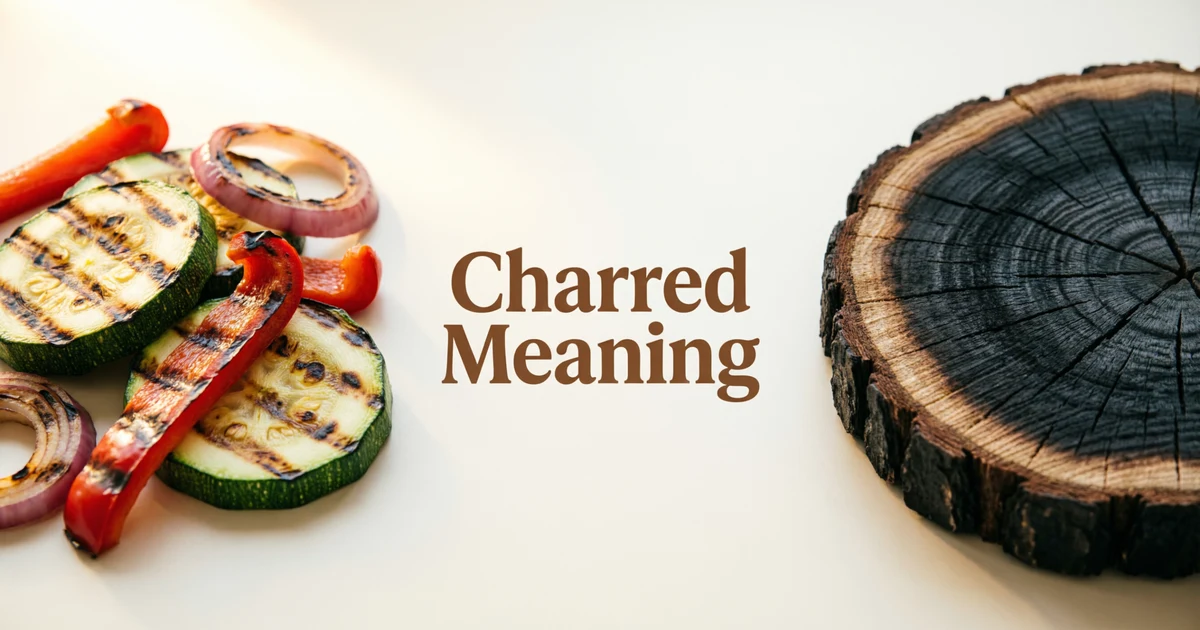
Charred means burned by strong heat or fire until the surface becomes dark, blackened, or partly carbonized. It can describe food, wood, buildings, plants, vehicles, and other materials exposed to intense heat.
In cooking, charred does not always mean ruined. A controlled amount of charring can give vegetables, meat, bread, or other foods a smoky flavor and dark surface. In descriptions of fires or accidents, however, charred usually refers to serious burning and visible blackening.
Introduction
You may see the word charred in a recipe, restaurant menu, fire report, news story, novel, or everyday conversation. Although the basic idea is connected with burning, the exact meaning changes slightly depending on what is being described.
When someone talks about charred peppers or charred corn, the word can describe an intentional cooking technique. The food develops dark areas through direct or intense heat. In this situation, charring may add flavor rather than indicate a cooking mistake.
The same word sounds much more serious in phrases such as charred wood, charred remains, or a charred building. Here, it means that fire or extreme heat badly burned and blackened something. Dictionaries generally define charred as burned, blackened, scorched, or partly converted into carbon through heat.
Understanding the surrounding sentence makes the intended meaning easy to identify. This guide explains what charred means, how it differs from burned and scorched, how people use it in cooking and everyday English, and which common mistakes to avoid.
| Meaning | Where It Is Used | Simple Explanation | Example |
|---|---|---|---|
| Burned and blackened | Fires and damage | Heat has made something dark or black | Charred wooden beams remained after the fire |
| Intentionally blackened | Cooking | High heat creates dark areas for flavor | The chef served charred corn |
| Partly carbonized | Materials and wood | Heat has changed part of the surface into carbon | The logs were charred around the edges |
| Descriptive language | Stories and reports | Emphasizes visible damage from intense heat | They found charred furniture inside |
What Does Charred Mean?
The most common meaning of charred is burned enough that the affected surface becomes black or very dark. The word comes from the verb char, which can mean to burn something partly or turn it toward charcoal through heat.
For example:
The flames charred the wooden fence.
Afterward, you could describe it as a charred fence.
The word can function as part of a verb phrase or as an adjective describing the condition of something.
You might encounter phrases such as:
- charred wood
- charred vegetables
- charred meat
- charred remains
- charred walls
- charred trees
- charred edges
- charred debris
The level of damage depends on context. Charred does not automatically mean that an object has completely turned into charcoal. Something may simply have a heavily blackened surface.
When the word describes food, the level of charring is often much smaller and more controlled. A cook may deliberately expose part of the food to intense heat to create darker areas and deeper flavor.
Charred Meaning in Cooking
In cooking, charred usually describes food that has developed deliberately dark or blackened areas after exposure to strong heat.
Common examples include:
- charred corn
- charred peppers
- charred onions
- charred broccoli
- charred tomatoes
- charred steak
- charred bread
The goal is usually not to turn the entire food black. Instead, selected areas become deeply browned or blackened while the rest remains properly cooked.
That distinction matters because charred food and badly burned food are not necessarily the same thing. Culinary charring is generally controlled. Burned food has usually gone too far and may taste excessively bitter, dry, or unpleasant. Culinary sources commonly describe successful charring as a balance between darker carbonized areas and properly cooked food.
For example, corn placed directly over a hot grill may develop scattered black spots. Those areas can add a roasted or smoky character while the kernels remain juicy.
If the whole ear becomes dry, bitter, and completely black, most people would call it burned rather than pleasantly charred.
Charred vs Burned vs Scorched
These words are related, but they are not always interchangeable.
| Term | Meaning | Best Use | Example |
|---|---|---|---|
| Charred | Blackened by strong heat | Visible black surface or controlled cooking | The peppers were charred |
| Burned | Damaged by heat or fire | General heat damage | I burned the toast |
| Scorched | Lightly or superficially burned | Surface heat damage | The iron scorched the fabric |
| Carbonized | Changed into carbon through strong heat | Scientific or technical descriptions | The outer material became carbonized |
Burned is the broadest term. Something can be burned without becoming completely black.
Scorched often suggests surface damage caused by heat. The damage may be lighter than what people normally imagine when hearing charred.
Charred strongly suggests visible darkening or blackening.
Carbonized is more technical and focuses on the chemical or physical change caused by strong heat.
Context still matters. Everyday speakers do not always use these words with scientific precision.
Is Charred the Same as Burnt?
Not exactly.
Burnt and burned can describe many types of heat damage, while charred usually gives a more specific visual impression of a dark or blackened surface.
You might say:
The cookies are burnt.
That usually means they were cooked too long and are no longer desirable.
You might also say:
The edges of the peppers are charred.
That could be positive because the darkened areas may have been created intentionally.
With buildings or objects, the words can overlap more closely.
A burnt house and a charred house both suggest fire damage, but charred places greater emphasis on visible blackening.
How Charred Is Used in Everyday English
Charred is most commonly used as a descriptive word. It helps a reader immediately picture the effect of intense heat.
Describing Fire Damage
After a serious fire, people may describe objects as charred when they have become blackened.
Examples:
Firefighters walked past charred wooden beams.
Only charred sections of the fence remained.
The fire left several trees charred.
In these examples, the word communicates visible damage rather than simply saying that something became hot.
Describing Food
Restaurants and recipes often use charred as a positive cooking description.
Examples:
We ordered charred broccoli with dinner.
She topped the tacos with charred corn.
The peppers were charred over an open flame.
Here, the speaker usually means controlled darkening rather than accidental destruction.
Describing Wood
Wood can become charred when fire or intense heat darkens its outer layer.
For example:
The campfire left the ends of the logs charred.
The flame charred the surface of the board.
Some woodworking traditions also deliberately char the surface of wood as part of a finishing or preservation process, although the exact techniques and results vary.
Charred in a Sentence
Seeing the word in different contexts makes its meaning easier to understand.
Food
The chef served charred tomatoes beside the grilled chicken.
We added charred onions to the sandwiches.
The corn had a lightly charred surface.
Fire damage
Investigators examined the charred remains of the shed.
Several charred branches fell from the damaged tree.
The firefighters removed charred pieces of wood.
Everyday descriptions
The candle flame charred the edge of the paper.
One side of the wooden sign became charred from the heat.
The old log was black and charred around one end.
Notice how the same word can sound desirable when describing food and destructive when describing property.
What Does Lightly Charred Mean?
Lightly charred means that only a small portion of the surface has become dark or black from high heat.
This phrase appears frequently in cooking.
A lightly charred pepper might have several black spots while most of its surface remains red, green, or yellow.
A lightly charred piece of bread may have darker edges without being completely burned.
The word lightly tells you that the charring is limited rather than severe.
What Does Heavily Charred Mean?
Heavily charred indicates much stronger burning.
The surface may be extensively blackened, damaged, brittle, or partly carbonized.
For example:
The firefighters found a heavily charred door near the source of the fire.
The phrase often appears in descriptions of structural damage, wildfire damage, or badly burned materials.
In cooking, heavily charred can also describe food with many dark areas, although whether that is desirable depends on the dish and the amount of burning involved.
Similar Words and Related Terms
Several words appear in similar contexts, but each carries a slightly different meaning.
Blackened
Blackened simply describes something that has become black or much darker.
In cooking, blackened can also refer to a specific style involving seasoning and high heat. It should not automatically be treated as identical to charred.
Singed
Singed usually describes very light burning, often affecting the tips or surface of hair, fabric, feathers, or similar material.
For example:
The flame singed the edge of the cloth.
That normally suggests less damage than charred.
Scorched
Scorched suggests damage caused by heat, especially on a surface.
A hot pan may scorch a countertop without turning it completely black.
Toasted
Toasted usually describes intentional browning caused by heat.
Bread can be toasted without becoming charred.
Grilled
Grilled describes the cooking method rather than the degree of browning.
Food can be grilled without being charred, although grilling often creates charred areas.
Does Charred Always Mean Completely Burned?
No.
This is one of the biggest misunderstandings surrounding the word.
Charred can describe something that has only been burned on its surface. Merriam Webster includes both burning toward charcoal and burning partly or slightly within the meanings of the verb char.
Imagine a wooden board placed too close to a fire. Its outer surface might turn black while the wood underneath remains solid.
You could still describe the board as charred.
The same principle explains why charred food does not have to be completely black.
Common Mistakes When Using Charred
The word is simple, but a few common mistakes can change the meaning of a sentence.
Assuming Charred Always Means Ruined
Charred food may be intentional.
Charred vegetables on a restaurant menu usually indicate a cooking style rather than a kitchen accident.
Treating Charred and Burned as Perfect Synonyms
Burned is more general.
Charred normally emphasizes blackening caused by intense heat.
Something can therefore be burned without becoming noticeably charred.
Assuming Charred Means Completely Turned Into Charcoal
A charred object may only have a carbonized or blackened outer layer.
The entire object does not need to become charcoal.
Confusing Charred With Grilled
Grilling is a cooking method.
Charring is an effect of intense heat.
You can grill something without creating much char, and you can char food using other high heat cooking methods.
Assuming It Has a Major Slang Meaning
Charred is primarily a standard English word describing something burned or blackened by heat. Search results may occasionally produce unusual slang pages or unrelated interpretations, but these are not the dominant everyday meaning. Standard dictionaries consistently center the heat and burning definition.
How to Understand Charred From Context
When you encounter the word, look at the noun immediately around it.
If the sentence mentions food, cooking, grilling, roasting, vegetables, or meat, charred probably describes intentional surface blackening.
If the sentence mentions a house, wildfire, accident, vehicle, debris, or damaged wood, it probably refers to destructive burning.
For example:
The restaurant serves charred cabbage.
This sounds intentional and culinary.
The firefighters found charred furniture.
This clearly describes fire damage.
Context usually removes any ambiguity.
Conclusion
Charred means burned by strong heat until the surface becomes dark, blackened, or partly carbonized. The word commonly describes fire damaged objects, wood, plants, and intentionally darkened food.
The key is context. Charred vegetables can be desirable because controlled heat creates dark areas and stronger flavor. A charred building, however, indicates serious fire damage.
Remember that charred is more specific than the general word burned. It usually draws attention to the visible blackening created by heat.
FAQs
What does charred mean in simple words?
Charred means burned enough by fire or strong heat that the surface becomes dark or black.
What does charred mean in food?
In food, charred usually means intentionally cooking the surface with strong heat until some areas become very dark or black. Controlled charring can add smoky and roasted flavors.
Is charred food the same as burned food?
Not always. Charred food can contain intentionally darkened areas while remaining enjoyable. Burned food usually suggests that cooking went too far and damaged the taste or texture.
What does charred wood mean?
Charred wood is wood whose surface has been blackened or partly carbonized through exposure to fire or strong heat.
Does charred mean completely black?
No. Something can be described as charred even when only part of its surface has become blackened.
What is the difference between scorched and charred?
Scorched generally suggests surface damage from heat. Charred usually suggests stronger burning that produces noticeable dark or black areas.
Can charred have a positive meaning?
Yes, particularly in cooking. Charred corn, vegetables, or meat may describe deliberate high heat cooking that produces desirable dark areas and deeper flavor.
What is another word for charred?
Depending on context, similar words include burned, burnt, scorched, blackened, singed, and carbonized. They are related but do not always mean exactly the same thing.