Quick Answer
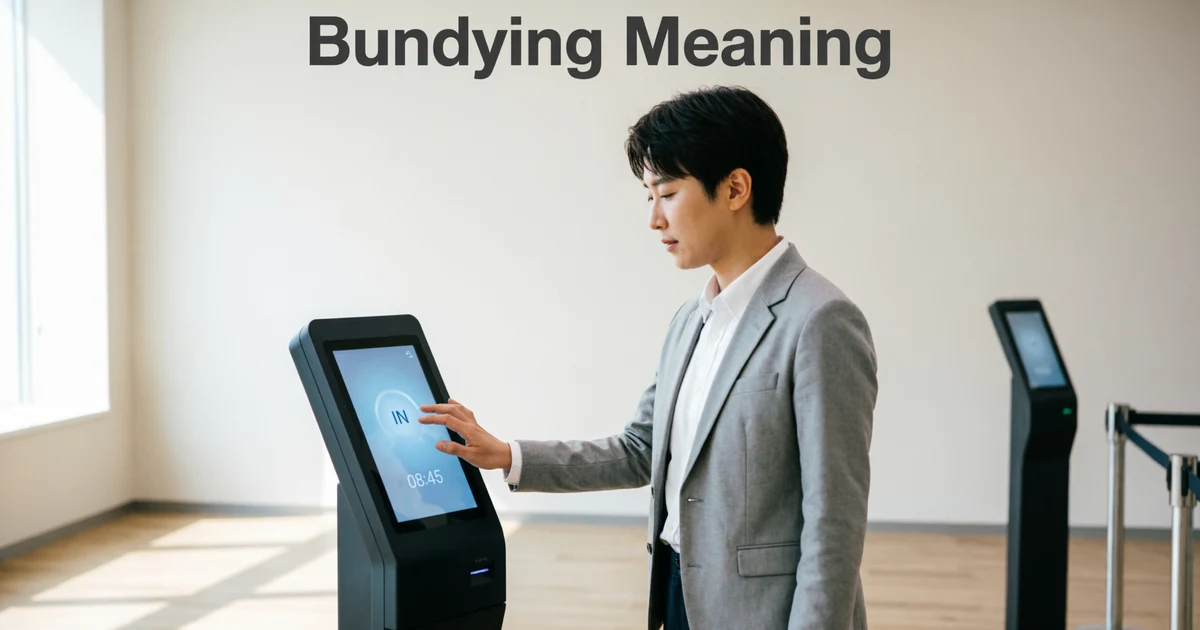
Bundying is an uncommon word most reliably associated with Australian workplace slang. It comes from the verb bundy, which means to register your arrival or departure from work using a time clock. Someone who is bundying on is clocking in, while someone bundying off is clocking out. Dictionaries identify bundy as an Australian term connected with a workplace time clock.
The word can occasionally appear with completely different meanings in informal online slang. Because those meanings are much less standardized, context matters.
Introduction
If you searched for bundying, you may have found several very different explanations. That happens because it is not a common everyday word in American English. Its meaning depends heavily on where you saw it and what words appeared around it.
The clearest established meaning comes from Australian English. In workplace language, bundy can refer to a time clock and can also function as a verb connected with recording when someone starts or finishes work. The forms bundying on and bundying off therefore work much like clocking in and clocking out.
Online slang adds another layer of confusion. Some small communities use bundy or bundying for unrelated actions, including vomiting after drinking or using drugs. Other expressions, such as Al Bundying, are references to the television character Al Bundy and have separate meanings.
For most readers, the surrounding sentence is the fastest way to determine what bundying means. This guide explains the established workplace meaning first, then covers the less common slang uses and words that are easy to confuse with it.
| Term | Meaning | Tone | Example |
|---|---|---|---|
| Bundying on | Clocking in for work | Informal Australian | She is bundying on for her shift |
| Bundying off | Clocking out from work | Informal Australian | He is bundying off for the day |
| Bundy | A workplace time clock, or the related verb | Australian | Remember to use the bundy |
| Bundying | Using bundy as an ongoing action | Informal | They are bundying on now |
| Al Bundying | A separate pop culture expression | Informal slang | The phrase refers to Al Bundy |
| Bunding | Building or using a containment barrier | Technical | The tank area needs proper bunding |
What Does Bundying Mean?
In its clearest dictionary supported sense, bundying is the present participle of the Australian verb bundy. The verb is normally used with on or off.
To bundy on means to arrive at work and register your starting time. To bundy off means to record that you are leaving or finishing your work period.
In American English, the closest everyday expressions are:
- Clocking in
- Clocking out
- Punching in
- Punching out
- Signing in
- Signing out
For example, an Australian worker might say:
I am bundying on now.
An American worker would be much more likely to say:
I am clocking in now.
The meaning is essentially the same in this context.
Bundy can also refer to the actual time clock used to record working hours. Collins identifies the word as Australian and gives both the time clock meaning and the verb describing arrival or departure from work.
Because bundying is uncommon in everyday American conversation, readers should not assume that everyone will recognize it.
Where Did the Workplace Meaning Come From?
The workplace meaning is connected with the Bundy clock, an early type of employee time recording machine. Time clocks were used to record when workers began and ended their shifts.
The name Bundy became associated with time recording equipment and later developed into Australian workplace vocabulary. Collins notes that the word comes from a trademark and recognizes bundy as both a noun for a time clock and a verb related to registering arrival or departure from work.
This explains expressions such as:
Bundy on
Bundy off
Punch the bundy
Bundying on
Bundying off
The wording may sound unusual to someone familiar only with modern digital attendance systems, but the concept is simple. It is another way of talking about recording work time.
What Does Bundying On Mean?
Bundying on means registering that you have started work.
Imagine an employee arriving for a morning shift. They enter the workplace and use a time recording system before starting their duties. In Australian slang, this can be described as bundying on. Wiktionary records bundy on as an Australian slang expression meaning to check in or clock in.
Natural examples include:
I am bundying on before I head to the warehouse.
Everyone needs to bundy on before starting their shift.
She was bundying on when her manager called her.
Although modern workplaces may use an app, card, fingerprint scanner, or another system instead of a mechanical clock, the expression can still communicate the general idea of recording the start of work.
What Does Bundying Off Mean?
Bundying off means registering that you have finished work or are leaving the workplace.
It is the opposite of bundying on. Wiktionary identifies bundy off as Australian slang meaning to check out or clock out.
For example:
I am bundying off and heading home.
He forgot to bundy off after his shift.
They were bundying off at the end of the day.
For an American reader, replacing bundying off with clocking out will usually make the sentence immediately clear.
Bundying in Everyday Conversation
Bundying is highly context dependent. You are far more likely to encounter it in Australian speech, historical workplace discussions, word games, or online conversations than in ordinary American workplace language.
If someone says:
I was bundying on at six this morning.
The context clearly points toward work attendance.
If someone says:
Do not forget to bundy off tonight.
They are probably reminding someone to record their finishing time.
If you are writing for an international audience, clocking in and clocking out are usually clearer choices because more readers recognize them immediately.
Bundying can still be appropriate when quoting Australian speech, discussing Australian vocabulary, or explaining historical workplace terminology.
Bundying Versus Clocking In
1-Bundying and clocking in can describe the same action, but they do not have the same geographic familiarity.
| Term | Meaning | Best Use | Example |
|---|---|---|---|
| Bundying on | Recording the start of work | Australian informal usage | He is bundying on |
| Clocking in | Recording the start of work | General workplace English | He is clocking in |
| Punching in | Recording the start of work | Informal workplace English | She punched in at eight |
| Signing in | Recording arrival | Workplaces, schools, offices | Please sign in at reception |
| Bundying off | Recording the end of work | Australian informal usage | She is bundying off |
| Clocking out | Recording the end of work | General workplace English | She is clocking out |
For American readers, clocking in and clocking out will usually sound more natural.
Does Bundying Mean Vomiting?
In some niche online slang, bundy has been used as a verb meaning to vomit, particularly in descriptions involving excessive alcohol or drug use. One user generated slang definition uses bundying in this sense.
This should not be treated as the standard meaning of the word.
For example, a slang sentence might describe someone as bundying after a night of heavy drinking. In that context, the meaning has nothing to do with workplace attendance.
Because this use comes from informal community slang rather than a broadly established definition, you should interpret it cautiously. Slang can vary between friend groups, schools, regions, and online communities.
If the surrounding discussion involves shifts, employees, hours, or attendance, the workplace meaning is much more likely.
If the conversation involves being sick after drinking, a niche slang meaning may be intended.
What Does Al Bundying Mean?
Al Bundying is another expression that can appear in online searches, but it should not be confused with the workplace meaning of bundying.
The phrase references Al Bundy, the fictional character from the television series Married with Children. One online slang use describes Al Bundying as relaxing or sleeping with a hand inside the pants, reflecting a familiar pose associated with the character. Other user submitted definitions give the expression different meanings.
That inconsistency is important.
Al Bundying is informal pop culture slang. It does not provide a reliable definition for the standalone word bundying.
When Al appears before Bundying, treat the entire phrase as a separate expression.
Bundying Versus Bunding
One of the easiest mistakes is confusing bundying with bunding.
They are not automatically the same word.
Bunding is a technical term commonly associated with containment. A bund can be a barrier or retaining structure designed to contain liquid or control its movement. You may encounter bunding when reading about fuel tanks, chemical storage, water management, industrial sites, or environmental protection.
Bundying, by contrast, can be the grammatical form of the Australian workplace verb bundy.
Consider these examples:
The workers are bundying off after their shift.
Here, the subject is workplace attendance.
The storage tanks require additional bunding.
Here, the subject is containment.
If you see bundying used in a technical article about tanks, spills, or barriers, check whether the writer actually intended to write bunding.
Is Bundying a Real Word?
Bundying does exist as a word form, but it is uncommon and regional.
The base word bundy is recognized in Australian English as a workplace term. Collins defines bundy as a time clock and as a verb used with on or off for arriving at or departing from work.
This makes forms such as:
Bundying on
Bundying off
grammatically understandable.
However, bundying is not a normal everyday term for most American English speakers. Someone encountering it without context may reasonably think it is a typo.
That does not make the word incorrect. It simply means its usefulness depends on the audience and context.
Examples of Bundying in Sentences
Seeing the term inside a sentence makes its meaning easier to recognize.
Workplace examples
I saw him bundying on when I arrived.
Everyone was bundying off after the evening shift.
She forgot to bundy on this morning.
Before leaving, make sure you bundy off.
The new employee did not know where to bundy on.
General English equivalents
I saw him clocking in when I arrived.
Everyone was clocking out after the evening shift.
She forgot to clock in this morning.
Before leaving, make sure you clock out.
These versions will usually sound more familiar to readers outside Australia.
Common Mistakes With Bundying
The biggest problem with bundying is not grammar. It is context.
Assuming bundying always means bunding
Bundying and bunding are easily confused because their spellings are almost identical. If a discussion involves liquid containment, tanks, flooding, or barriers, bunding may be the intended word.
Treating niche slang as the main definition
Online slang dictionaries contain user submitted meanings that may belong to a very small community. A slang definition should not automatically replace an established regional dictionary meaning.
Assuming every English speaker knows the word
Bundying may need explanation when writing for an American or international audience. Clocking in and clocking out are usually clearer.
Confusing Bundying with Al Bundying
Al Bundying is a separate pop culture expression. The presence of Al changes the context significantly.
Ignoring the words on and off
In workplace usage, bundy commonly appears with on or off. These words tell you whether someone is beginning or ending work.
How to Understand Bundying From Context
When you encounter bundying online, look at the surrounding words before choosing a definition.
If the sentence mentions work, employees, shifts, attendance, hours, a time clock, starting work, or finishing work, bundying probably relates to clocking in or out.
If it mentions alcohol, drugs, sickness, or vomiting, it may represent niche slang.
OR, If the phrase specifically says Al Bundying, it probably refers to the television character rather than workplace attendance.
If the discussion involves storage tanks, spills, chemicals, water, barriers, or containment, check whether the intended word is actually bunding.
This simple context check prevents most misunderstandings.
Similar Terms and Related Phrases
Several expressions can overlap with the workplace meaning of bundying.
Clocking in means registering the beginning of a work period.
Clocking out means registering the end of a work period.
Punching in comes from traditional time card systems and means recording your arrival.
Punching out means recording your departure.
Signing in can mean recording your arrival at a workplace, school, building, meeting, or event.
Signing out records that you are leaving.
These terms are generally easier to understand in American English than bundying.
Conclusion
Bundying most reliably refers to the ongoing action of using the Australian verb bundy, especially in expressions such as bundying on and bundying off. In simple terms, these mean clocking in and clocking out of work.
The word can also appear in niche internet slang with unrelated meanings, so context matters. Do not automatically confuse bundying with bunding, the technical term associated with containment barriers, or with Al Bundying, which is a separate pop culture expression.
When in doubt, look at the surrounding sentence. Work and shift language usually points to the workplace meaning.
FAQs
What does bundying mean in slang?
Bundying can have different informal meanings. Its established Australian workplace use relates to clocking in or out. Some niche online communities also use it with unrelated slang meanings, so context is important.
What does bundying on mean?
Bundying on means registering your arrival at work or clocking in. It is an Australian informal expression.
What does bundying off mean?
Bundying off means registering that you are leaving work or clocking out. It is the opposite of bundying on.
Is bundying an Australian word?
The base word bundy is recognized as Australian English. It can refer to a workplace time clock and can function as a verb associated with registering the beginning or end of work.
Does bundying mean throwing up?
It can have that meaning in some niche user generated slang, particularly in discussions involving alcohol or drugs, but this is not the main established dictionary meaning.
Are bundying and bunding the same thing?
No. Bundying can be a form of the Australian workplace verb bundy. Bunding commonly refers to creating or using a containment barrier. Always check the context before deciding which word is intended.
What is another word for bundying on?
Clocking in, punching in, and signing in are useful alternatives. Clocking in is probably the clearest choice for most American readers.
Is Al Bundying the same as bundying?
No. Al Bundying is an informal pop culture expression based on the character Al Bundy. It should be treated separately from the Australian workplace term.